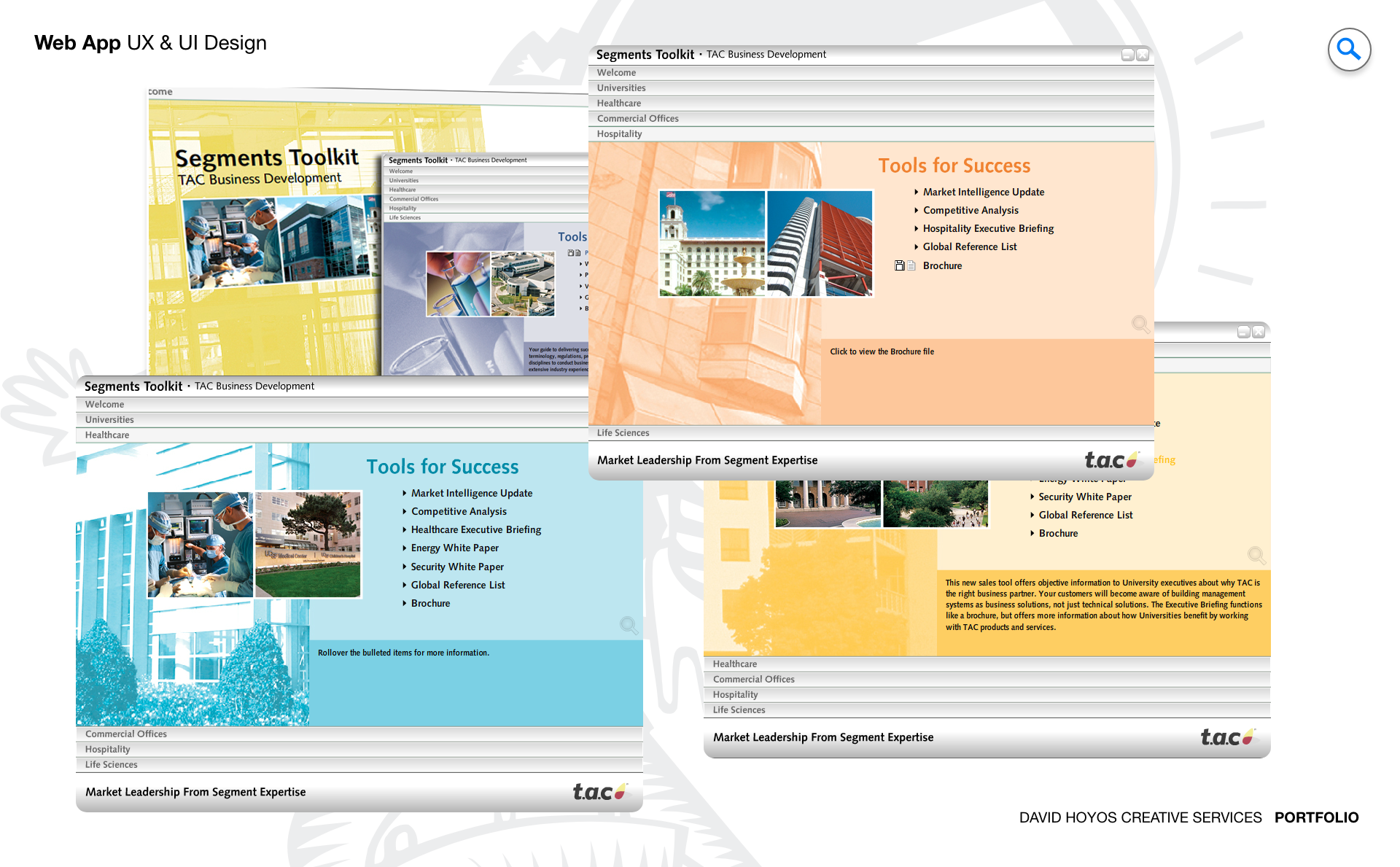
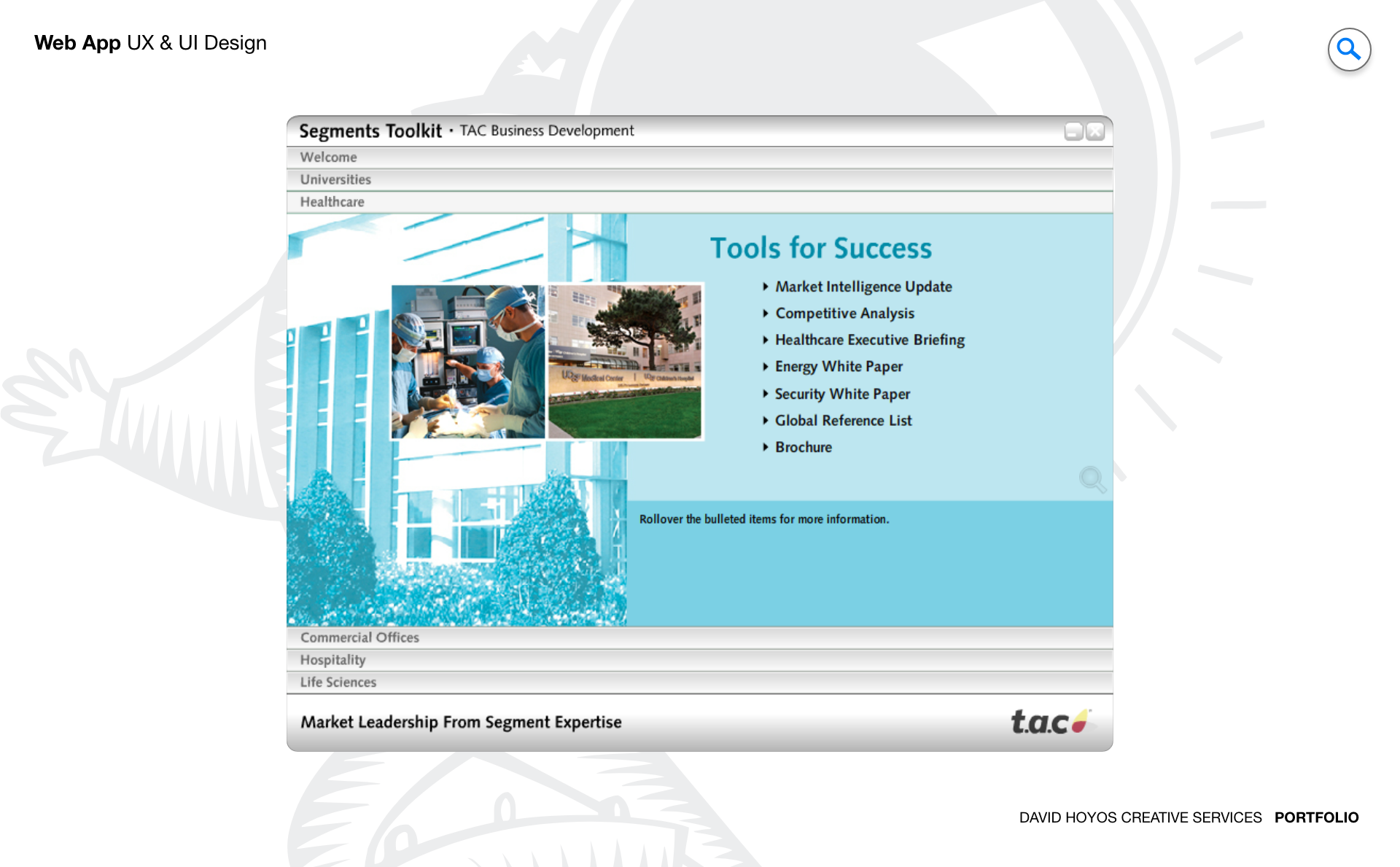
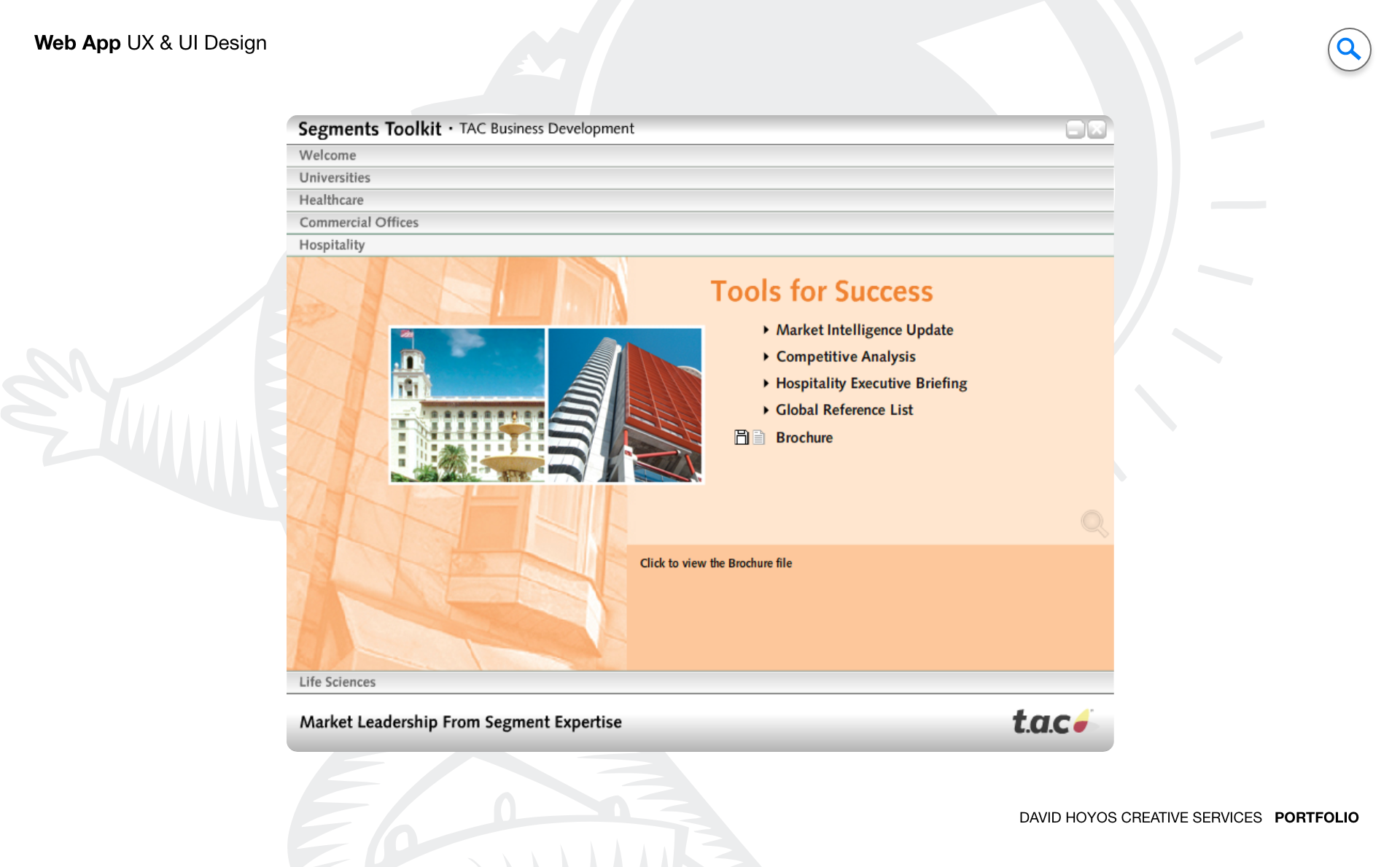
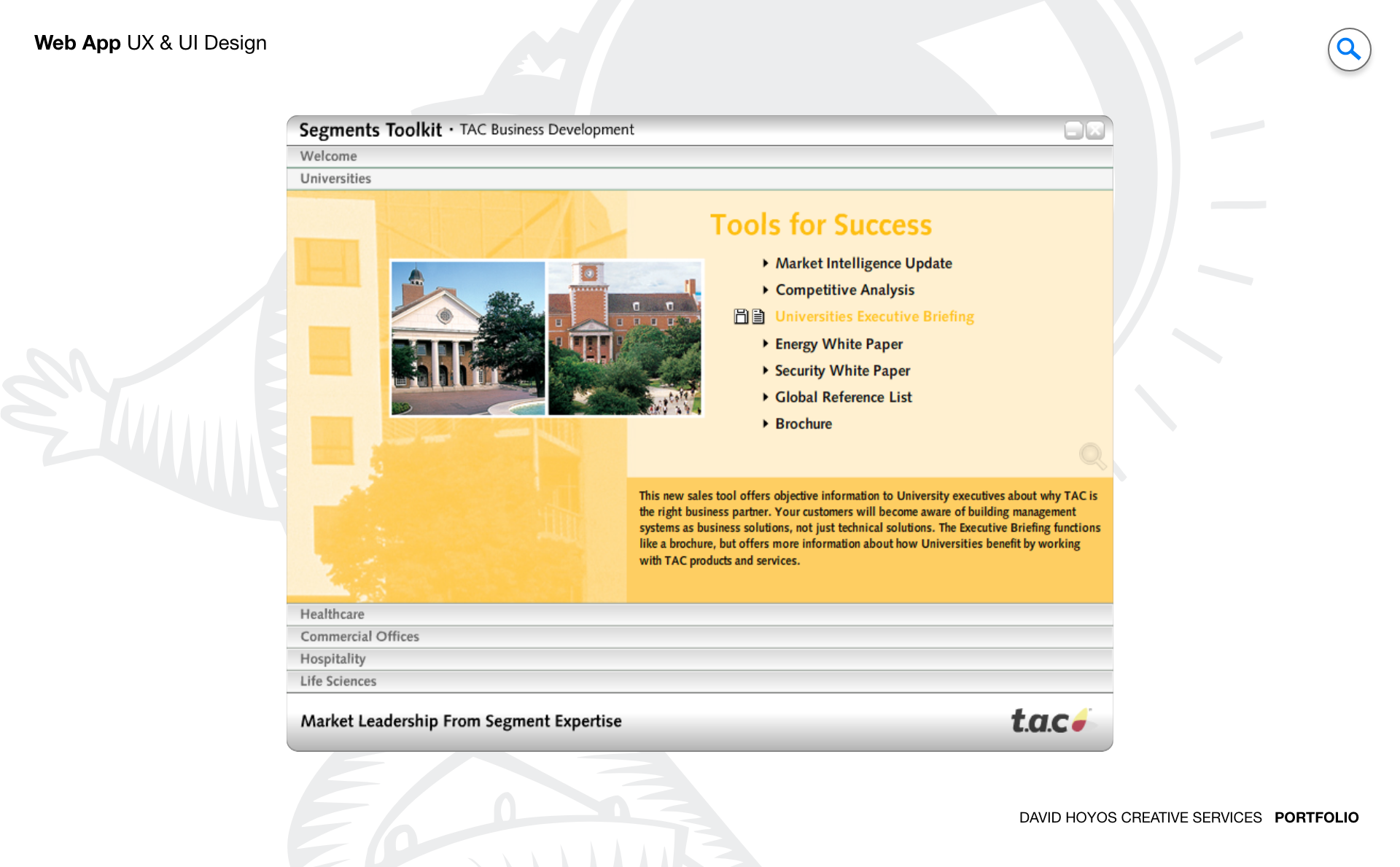
PROJECT Market Leadership From Segment Expertise Web App. Sales enablement tools succeed when they solve the right problem. The problem most sales forces face is not a shortage of information but a shortage of organized, accessible, and contextually relevant information at the moment they need it. A sales representative preparing for a meeting with a client in a specific market segment should not have to search through shared drives, email threads, and disconnected content repositories to assemble what they need. The TAC web app was designed to solve exactly that problem: a branded, centralized platform that gave the entire sales force immediate access to the resources, insights, and segment expertise that made them more effective in the field. The Market Leadership From Segment Expertise framing was not just a title. It was the organizing principle of the entire app. The platform was built around the premise that sales effectiveness in TAC's market was a function of deep segment knowledge, and the app was designed to build and reinforce that knowledge through the resources it surfaced, the interactive experiences it offered, and the collaborative environment it created. This was not a digital brochure or a document library. It was a tool designed to make the sales force better at their jobs. OBJECTIVE The objective was to design a visually appealing, fully branded web application that served as the indispensable resource hub for TAC's sales force, giving representatives fast, organized access to the product information, sales collateral, pricing details, and market segment insights they needed to succeed in client engagements. The interface was designed around the principle that a sales tool is only as good as the speed with which it gets a representative to the right information: every organizational decision, every navigation pattern, and every search and filter capability was designed to reduce the time between a representative's need and their access to the resource that addressed it. Beyond resource access, the objective extended to the interactive and social dimensions that made the app a living environment rather than a static repository. Interactive product demos, virtual tours, and multimedia presentations gave sales representatives the ability to engage deeply with TAC's offerings and understand the specific selling points relevant to each market segment. Discussion forums and chat capabilities created a community layer where the collective knowledge of the sales force could be shared, surfaced, and built on continuously. That combination of structured resources and emergent community knowledge was the design premise that made the app more valuable than any individual component of it. CHALLENGE Information organization at the scale of a full product and segment portfolio was the primary design challenge. A sales force covering multiple market segments requires a content taxonomy that serves every combination of product and segment without requiring the representative to know the taxonomy in advance. A new sales representative preparing for their first meeting with a technology client needs to find the same information as a veteran representative, through a navigation model that works for both. Designing an information architecture that was simultaneously comprehensive and accessible required treating the content organization as a first-class design problem rather than a structural decision made before the UX work began. Engagement was the second challenge. A resource hub that is technically complete but experientially dull is a resource hub that gets used once and then abandoned. Sales representatives who could get the same information from a shared drive with less friction would use the shared drive. The interactive elements, the multimedia content, and the social features were the design responses to that risk: the app had to be more valuable and more engaging than the alternatives, not just more organized. Designing interactivity that felt purposeful rather than decorative required close attention to which interactions were adding genuine value and which were adding complexity without return. Cross-device responsiveness added the operational dimension. Sales representatives use the app in the office, in transit, and in client meetings, across the full range of device types and network conditions those contexts implied. A resource that was not accessible from a tablet during a client meeting was a resource that would not be consulted during a client meeting, regardless of how well it was designed on desktop. Ensuring the full value of the app was available across every device required responsive design decisions integrated from the beginning rather than applied as a post-design adaptation. PERSONA(S) Sales people. Sales representatives at TAC: a professional audience with high performance expectations for the tools they use and a low tolerance for interfaces that slow them down. Sales people operate under time pressure and outcome accountability. They are preparing for meetings, responding to client questions, and building presentations under conditions where efficiency matters as much as depth. A tool that required extensive navigation to locate a specific piece of information was a tool they would use less frequently, not more. The design had to anticipate the most common paths a representative would take through the app and make those paths as direct and obvious as possible, while keeping the full depth of the platform accessible for the moments when a representative needed to go further. The sales persona also had a collaborative dimension that many enterprise software users do not. Sales teams build shared knowledge through informal communication: insights from successful client meetings, competitive intelligence gathered in the field, and segment expertise developed through experience. The discussion forums and chat features were designed for this persona specifically, creating structured channels for the kind of knowledge sharing that was already happening informally and giving it a permanent, searchable home in the platform rather than letting it disappear in a chat thread. INDUSTRY Technology Technology: a sector where sales expertise is closely tied to the ability to navigate complex product portfolios and articulate differentiated value across multiple buyer personas and market segments. Technology sales is a knowledge-intensive discipline. The representatives who succeed are the ones who understand their products deeply enough to connect them to the specific problems their clients are trying to solve, across a range of industries and use cases that can be very different from each other. A sales enablement app for a technology company had to support that depth of knowledge, not just provide access to marketing materials. The segment expertise framing of the app reflected an understanding that the competitive advantage TAC's sales force needed was not more information but better organized, more deeply understood information about the specific segments they were selling into. The technology industry context also shaped the expectations the sales force brought to the tool. Technology sales representatives work with software every day and have high standards for the products they use professionally. A sales enablement app that did not meet the design and performance standards of the other tools in their workflow would face skepticism and low adoption regardless of the quality of its content. The design had to earn the trust of a technically sophisticated audience by being demonstrably well-built and well-designed, not just well-intentioned. PROCESS Assessment + Exploration + Design + Production + Deployment. Assessment began with a study of how TAC's sales force was currently accessing and using resources: which content types were most frequently needed, where representatives were losing time in their current workflow, and what the gap was between the information they had available and the information they actually needed in client engagements. The research identified fragmentation as the dominant problem: resources existed across multiple systems and formats, and the effort of assembling the right set for a specific client meeting was itself a significant time cost. The assessment created the design brief for a platform that reduced that fragmentation without adding a new layer of complexity to manage. Exploration tested the information architecture, the interactive content model, and the social feature design against the real usage patterns the assessment had revealed. The segment-based organization of the content was validated against how representatives actually thought about their client engagements: did they approach a client meeting by segment first, by product first, or by problem type? That answer shaped the primary navigation model of the app. Design, Production, and Deployment completed the full cycle, with the responsive design requirements integrated throughout to ensure the app worked as intended across every device and context where representatives would use it. DELIVERABLES Wires, High-Fidelities, BuildKit (specs). Wireframes for the TAC web app had to resolve the information architecture across the full content scope before any visual design decisions were made. The wire phase established the navigation model, the content categorization structure, the search and filter logic, and the layout patterns for each major content type: resource pages, interactive demos, segment profiles, and the social and collaboration surfaces. Getting the information architecture right in wire form was particularly important on this project because the content taxonomy was the foundation on which everything else was built, and a flawed taxonomy would have required structural rework at a later and more expensive stage. High-fidelity designs applied TAC's brand identity across the full app: the company logo, color palette, and typographic system integrated into an interface professional and polished enough to represent the organization in the client-facing contexts where sales representatives would use it. The BuildKit delivered the complete implementation specification for engineering: every component state, every responsive breakpoint behavior, every interactive element behavior, every social feature interaction pattern, and every animation specification, organized to give the development team a complete and unambiguous reference for building the app as designed and tested. TEAM UX + UI + Research + Front-end Developer + Information Architect + PM UX, UI, Research, a Front-end Developer, an Information Architect, and Product Management. The Information Architect's presence was as important to this project as it was distinctive. A sales enablement platform organized around market segment expertise is fundamentally an information architecture problem before it is a design problem: the taxonomy that determines how content is categorized, how it is labeled, and how it is navigated shapes every subsequent design decision. Having an Information Architect who owned those decisions from the beginning produced a content structure that was grounded in how the sales force actually thought about their work, rather than how the product team assumed they did. Research grounded the content organization and feature prioritization in real sales representative behavior, ensuring the app was built around how the sales force worked rather than how it was assumed to work. The front-end developer's involvement during design exploration ensured that the interactive elements and social features were designed with technical feasibility in view throughout. Product Management kept the app aligned with TAC's business objectives and the specific knowledge gaps the platform was designed to close, maintaining that connection between design decisions and business outcomes across every phase of the project. ROLE Design leadership and execution. Design leadership and execution across UX and UI for the full scope of the TAC web app. At the leadership level, that meant establishing the design vision for a platform that had to function simultaneously as a professional resource hub, an interactive learning environment, and a community platform for a sales force whose performance depended on the quality of what it provided. Those three functions had to coexist in a single, coherent interface without any of them feeling underdeveloped, which required a design vision that held all three in frame and a set of priorities that resolved conflicts when they arose. At the execution level, the role covered the wireframes, high-fidelity designs, and BuildKit across an app with a wide feature surface: the content organization system, the interactive demo and multimedia experiences, the social and collaboration tools, and the responsive layout system that made all of it accessible across every device. Maintaining quality and coherence across that full scope while keeping the design grounded in the real behavior of TAC's sales force was the execution challenge that defined the role throughout the project.