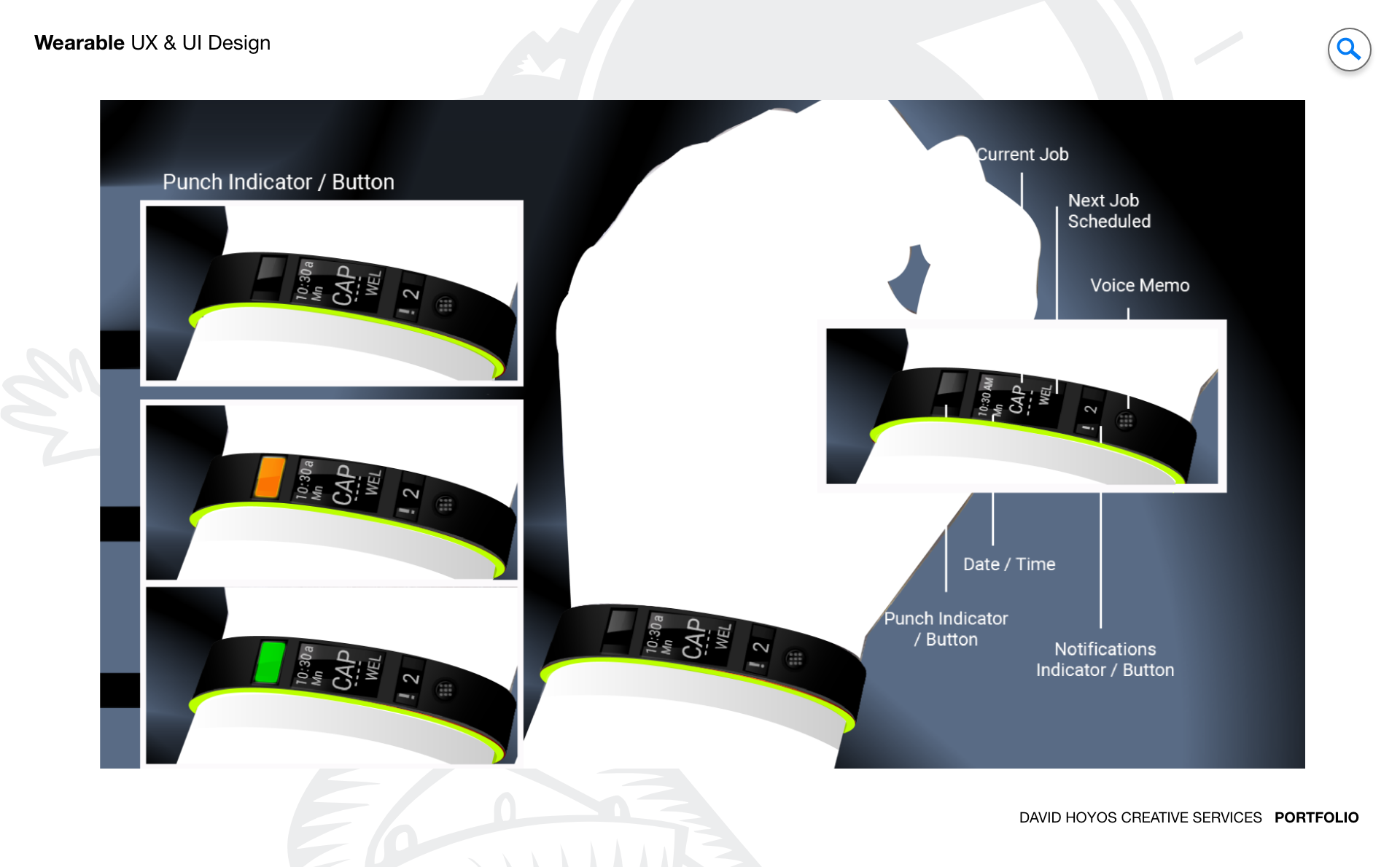
PROJECT Wearable Device - Concept Work Concept work occupies a different creative space than feature design. The goal is not to solve a known problem within established constraints but to explore what becomes possible when the constraints themselves change. This project asked a genuinely open question: what would a purpose-built wearable device for hourly workers look like, and what would it change about how those workers experienced their day? The answer took the form of a concept design grounded in real operational needs, built around a device that gave employees immediate, ambient access to the information and tasks that structured their work. The concept was developed for a workforce management context where the existing interaction model — pulling out a phone, finding an app, navigating to the right screen — created friction at precisely the moments when friction was most costly: mid-task, mid-shift, hands occupied, attention split. A wearable that surfaced the right information at the right time, without requiring deliberate attention from the user, was not a novelty but a functional improvement in how the platform could serve the people doing the actual work. OBJECTIVE The objective was to design a wearable device that gave hourly employees fast, effortless access to their daily schedules and tasks without pulling them out of the flow of their work. Hourly workers in retail, manufacturing, healthcare, and related industries operate in environments where stopping to check a phone is not always practical and sometimes not permitted. A wearable that surfaced schedule information, task notifications, and status updates on the wrist changed the access model entirely: the information came to the worker rather than requiring the worker to go find it. The design aimed to do more than replicate the phone experience on a smaller screen. The opportunity in wearable design is the ability to deliver contextually relevant information in the moment it matters, at a glance, without navigation. That required rethinking which information was worth surfacing on a device with a small display, how interactions were designed for a context where extended engagement was not possible, and what productivity actually meant on a device worn on the wrist during a physical workday. The goal was utility so immediate it felt invisible. CHALLENGE New technology, form factor, accessibility. New technology was the first challenge, and the most expansive one. Wearable design sits at the edge of what users have experience with, which means the usual design heuristics about established mental models and learned interaction patterns apply only partially. Hourly workers in industrial and retail environments had not, as a population, developed strong expectations about what a work-focused wearable should do or how it should behave. The design had to be intuitive enough to require no training while also introducing interaction paradigms that were genuinely new for this user base. Form factor shaped every decision in the project. A wearable is not a small phone; it is a categorically different kind of device. The display is small, the interaction surface is limited, the context of use is physical and often demanding, and the battery and performance constraints are real. Designing for a wearable meant accepting those constraints as the creative brief rather than trying to work around them. Every piece of information that made it onto the screen had to justify itself against the alternative of leaving it off, and every interaction had to be completable in the seconds a worker could spare before returning their attention to the task in front of them. Accessibility on a wearable introduced challenges that go beyond standard screen-based guidelines. A device worn on the wrist during a physical workday has to be readable in variable lighting conditions, operable with gloves or damp hands, and usable by workers across a wide range of ages and physical capabilities. The concept design had to address those conditions explicitly, because a wearable that is not accessible under real-world work conditions is not a productivity tool but a liability for the workers expected to rely on it. PERSONA(S) Employee The hourly employee is the sole persona for this project, which made the design focus unusually sharp. The wearable was conceived entirely around a single question: what does an hourly worker need to know and do during their shift, and how can a device on their wrist help them do it more efficiently? The answer varied by industry and role — a retail associate has different information needs than a healthcare aide or a manufacturing floor worker — but the underlying pattern was consistent: workers needed to know their schedule, their tasks, any changes to either, and any communications directed at them, accessible immediately without breaking their workflow. Hourly workers as a design audience also present specific considerations that a management-focused design might not prioritize: limited device familiarity in some demographics, physical work environments that create real interaction constraints, and a relationship to workplace technology shaped by whether technology has historically made their job easier or harder. A wearable that felt like surveillance rather than support would not be adopted regardless of its features. The design had to earn its place on the wrist by being obviously useful from the first interaction. INDUSTRY Retail, manufacturing, healthcare, hospitality, sales & distribution, government. Six industries where hourly workers share common scheduling and task management needs but experience those needs in very different physical environments. In retail and hospitality, the value of a wearable is immediate visibility into schedule changes, task assignments, and notifications without requiring the employee to step away from the sales floor or the service environment. In manufacturing and healthcare, the environments impose more demanding conditions: industrial settings with loud machinery, healthcare settings with infection control protocols, and both with physical demands that make phone-based interactions impractical during active work periods. In these environments, a glanceable wearable is not a convenience but a meaningful operational improvement. In sales and distribution and government, the geographic distribution of the workforce made the ambient connectivity of a wearable particularly compelling. Workers in the field, in transit, or across large facilities could receive schedule updates, task changes, and communications without needing to find a terminal or a reliable space to use a phone. The concept addressed the full range of these contexts and was designed to hold up under the most demanding of them. PROCESS Assessment + Exploration + Design Assessment began with a study of how hourly workers currently interacted with schedule and task information during their shifts, and where that interaction model broke down. Field observation revealed the moments where existing tools failed: the worker who missed a schedule change because they did not have a chance to check their phone, the task notification that arrived while both hands were occupied, the communication that required navigating to an app in a context where taking out a phone was disruptive or not permitted. Those failure points became the design brief for the wearable concept. Exploration tested the range of what the device could do and, importantly, what it should not do. Wearable design is as much about restraint as capability: a screen that tries to do too much becomes harder to read and harder to use than one that does a few things very well. Exploration established the hierarchy of information and interaction that belonged on the device versus what belonged on a paired phone application, and tested form and interaction concepts against the physical contexts where the device would be worn. Design brought those explorations together into a concept with a coherent visual language, a clear interaction model, and the prototype fidelity needed to test it as a real experience. DELIVERABLES Wires, HIgh-Fidelities, Prototype. Wireframes for a wearable device are structural decisions at a very small scale. Every element on a wearable screen has to earn its place because the total display area is a fraction of what a phone provides. The wire phase established the information hierarchy and interaction model for each screen state: what the device showed by default, how notifications were surfaced and dismissed, how an employee moved between their schedule, their tasks, and their messages without getting lost in a navigation structure too deep for a small display. High-fidelity designs applied the visual language of the product to the wearable form factor, addressing the specific rendering conditions of a small display: high contrast ratios for outdoor readability, generous touch targets for physical work contexts, and typography scaled for glanceability rather than extended reading. The prototype was the most important deliverable for a concept of this kind. A wearable interaction cannot be fully evaluated from a static design; it has to be experienced in motion, on the wrist, in the conditions it was designed for. The prototype gave stakeholders and test participants a real sense of the concept's value that wireframes and high fidelities alone could not provide. TEAM UX + UI + Research + PM UX, UI, Research, and Product Management: a lean team for a concept project, which placed the creative and research investment at the center of the work. Concept projects have a different success criterion than feature work: the goal is not to ship a spec but to build a compelling enough case for the concept that the organization can make an informed decision about whether and how to pursue it. That kind of case is built through the quality of the design work and the rigor of the research that grounds it, not through the size of the team. Research was particularly essential here because the wearable was a new device category for this user base. Designing for a form factor that workers had not previously experienced in a work context required understanding not just what they needed but how they would respond to a device that changed the interaction model in a fundamental way. The research function ran early-stage concept testing that shaped the design before significant resources were committed to high-fidelity work, which meant the prototype the team delivered reflected real user insight rather than internal assumptions about what hourly workers would find valuable. ROLE Creative leadership and execution. Creative leadership and execution. On a concept project, creative leadership carries a different weight than it does on a product feature. There is no existing design system to build on, no established interaction patterns specific to this device, and no prior version to reference when a decision is disputed. The creative leadership role was to establish the design vision for the wearable concept from first principles: what the device should feel like to wear and use, what visual language was appropriate for a screen read at a glance during a physical workday, and what interaction model would be intuitive for a user population that had not previously used a work-focused wearable. At the execution level, the role covered the full scope of the deliverables from wireframes through the prototype, working closely enough with research and product to ensure that the design was being shaped by real insight throughout. Concept work that is not grounded in research produces speculative designs that look interesting in a portfolio but do not build organizational confidence in the concept's viability. The execution discipline in this project was about making the concept credible, not just compelling.