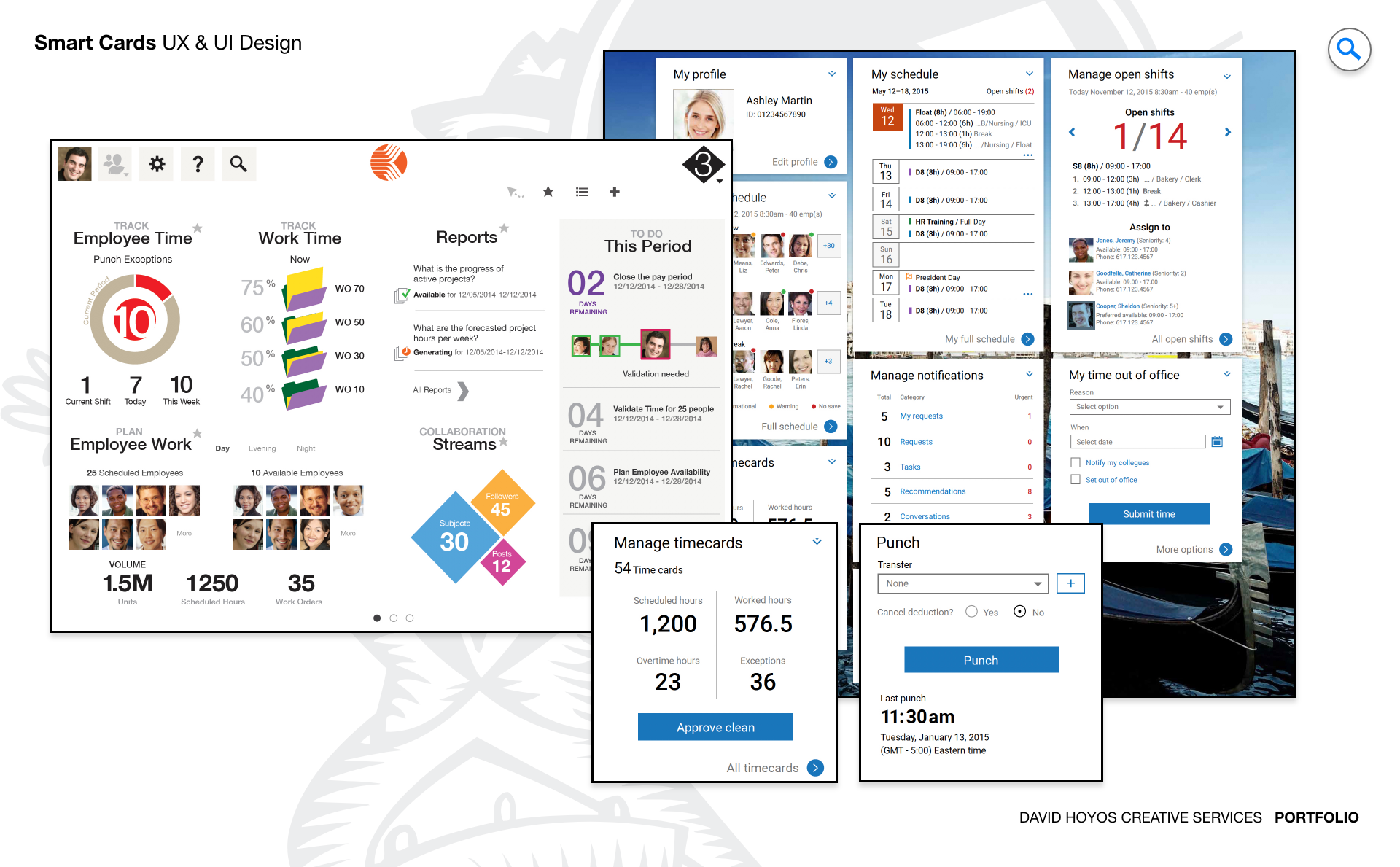
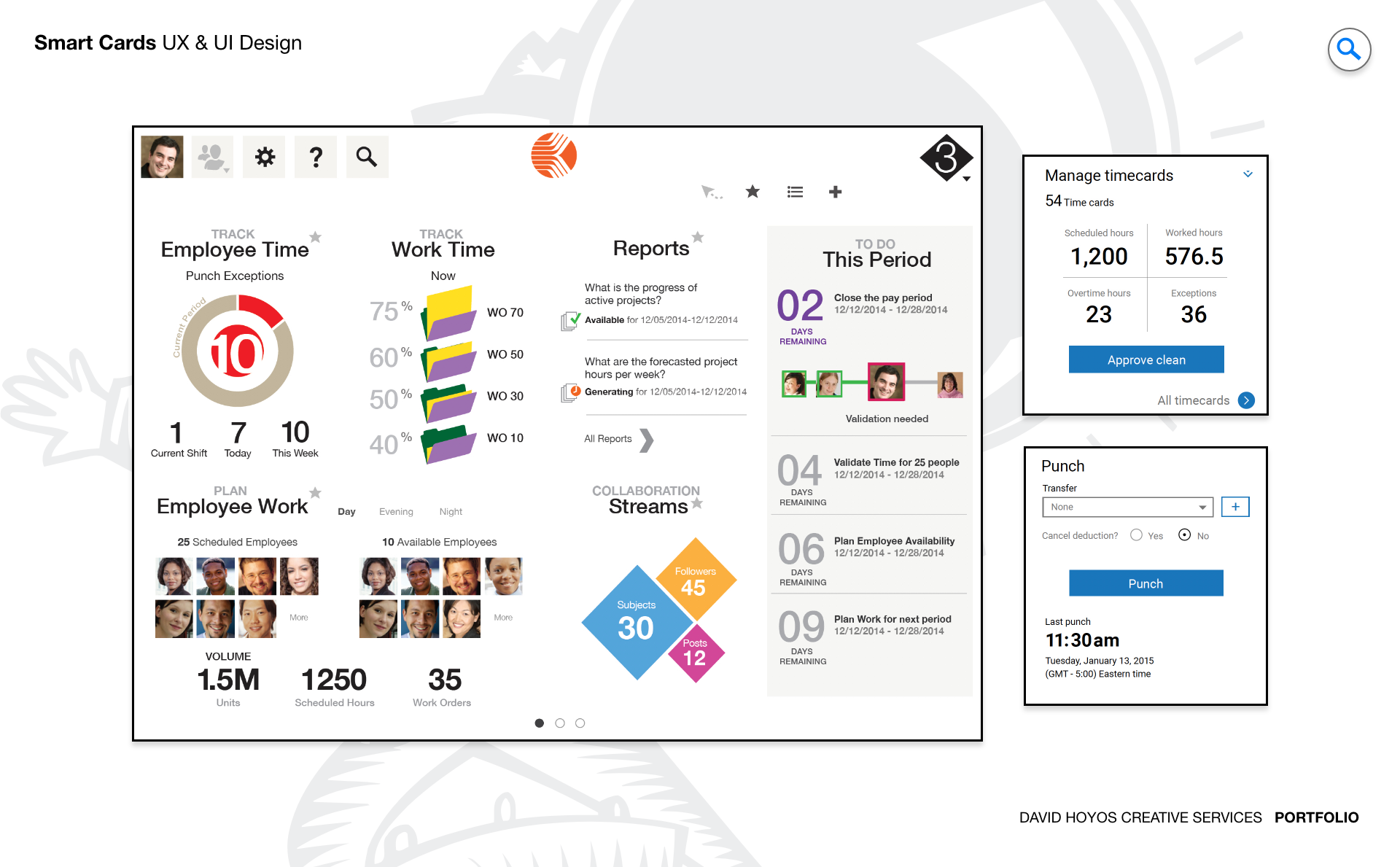
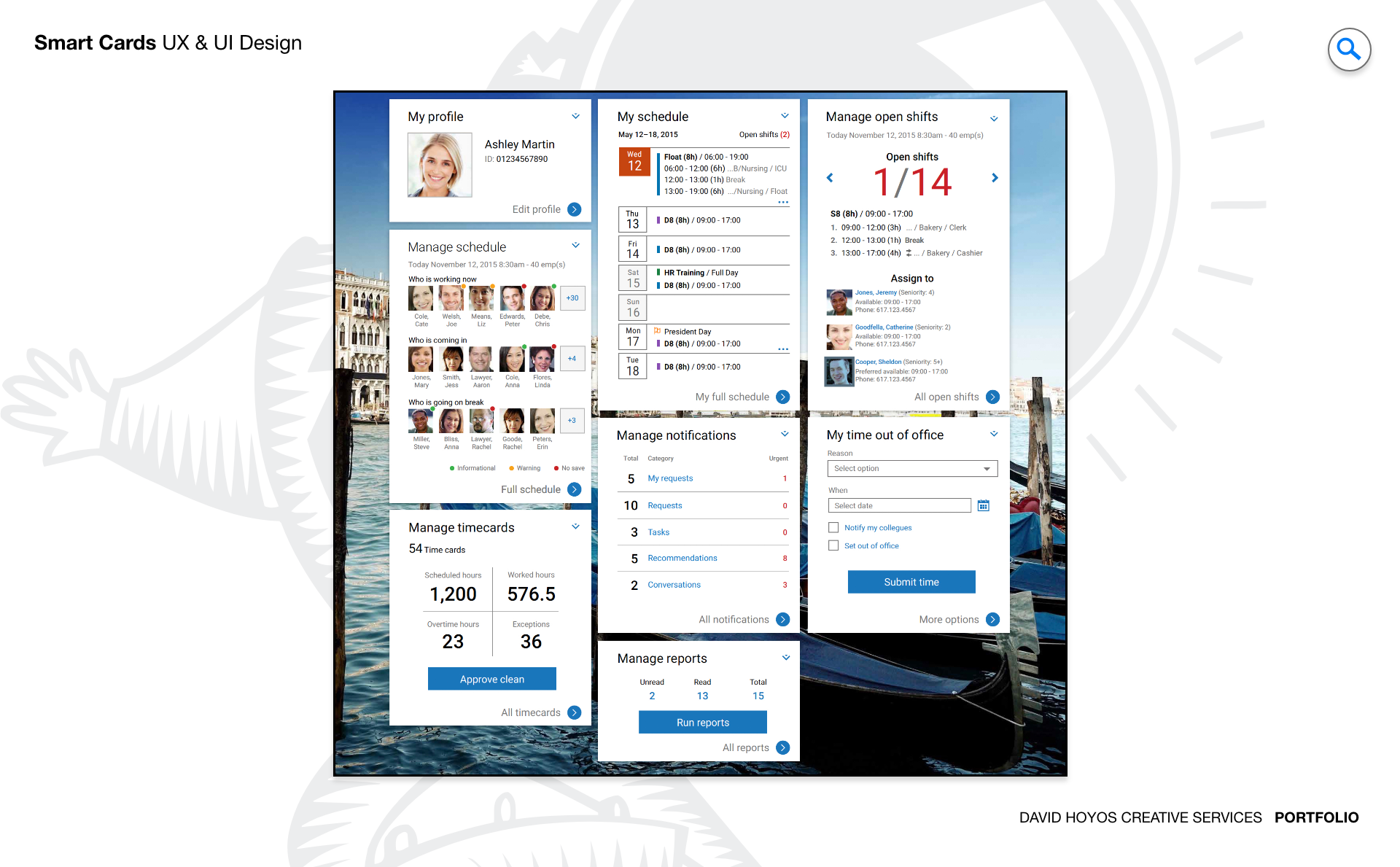
PROJECT Dynamic Smart Cards. A card is one of the most common patterns in enterprise software design, and one of the most commonly misused. A static card that displays fixed information in a fixed layout is a container. A dynamic smart card that surfaces contextually relevant information based on what is happening right now, for the specific manager looking at it, in the specific operational context they are managing, is a decision-support tool. This project was about designing the latter: a card system intelligent enough to know what a manager needed to see before they knew they needed to see it. The dynamic card system was built to serve as the connective tissue between the scheduling, task management, and request workflows that defined a manager's operational day. Rather than requiring managers to navigate to each of those areas separately to assemble a picture of what was happening across their team, the smart card system assembled that picture for them, surfacing the highest-priority information, the most time-sensitive requests, and the patterns in their team's data that warranted attention, all within a compact and scannable format designed for the moments between decisions. OBJECTIVE The objective was to give managers a comprehensive, real-time platform for understanding and acting on their team's schedules, tasks, and requests, delivered through a dynamic card system designed for speed and clarity. The insight that shaped the design was that managers in operational roles do not have the luxury of extended analytical sessions: they are making decisions throughout the day in brief windows of attention, often while managing competing demands. A system that required them to construct their situational awareness from multiple data sources was a system working against the way they operated. The smart card system addressed that by combining real-time data collection with analytics capabilities that identified patterns, trends, and potential bottlenecks before they became problems. A manager who could see at a glance that coverage was trending short for the afternoon, that three open shift requests had been waiting for over an hour, and that one employee's tasks were running behind could make three decisions in the time it would previously have taken to navigate to the relevant sections of the platform. That compression of insight into action was the core value the system was designed to deliver. CHALLENGE Screen real-state (form factor), information overload and balance. Screen real estate was the defining constraint. A smart card by its nature must be compact enough to coexist with other cards in a dashboard layout, which means the design challenge was fitting meaningful, actionable information into a format smaller than most people would choose if space were unlimited. The cards had to be dense enough to be useful but not so dense that they became difficult to scan quickly, and they had to maintain that balance across the range of device sizes and screen configurations that managers used in the field. Information overload was the design risk that lived on the other side of that constraint. A smart card system that tries to surface everything ends up communicating nothing: when every piece of information is equally prominent, the manager still has to do the work of finding the signal in the noise, just in a different format. The design had to make deliberate decisions about what belonged on a card and what did not, which meant building a clear philosophy around information hierarchy that was applied consistently across every card type in the system. Balance between those two pressures was where the real design work happened. Too much information and the cards became cluttered and hard to scan; too little and they lost the depth that made them worth consulting in the first place. Finding the right density for each card type required testing with real managers doing real operational tasks, validating that the information surfaced on each card was the information they needed rather than what seemed useful from the abstract vantage point of the design process. PERSONA(S) Manager The smart card system was designed exclusively for managers, which gave the design a sharp and well-defined target. Managers in operational roles live in a state of continuous, distributed attention: they are responsible for multiple people, multiple workflows, and multiple priorities simultaneously, and the tools they rely on have to match that mode of operation. A tool that requires sustained focus to extract value is a tool that competes with the manager's primary job rather than supporting it. The manager persona for this project was further defined by the operational context: frontline managers in industries where the workforce is hourly, where schedules change frequently, and where decisions have to be made quickly to keep operations running smoothly. These managers are not analysts with time to explore data at a desk; they are operators making rapid judgment calls based on whatever information they can access in the time available. The smart card system was designed to give them the best possible version of that information with the minimum possible effort to access it. INDUSTRY Retail, manufacturing, healthcare, government and hospitality. Five industries with different operational rhythms but a shared managerial challenge of maintaining situational awareness across a team without being able to watch everything at once. In retail and hospitality, the speed at which operational conditions change made the real-time dimension of the smart card system its most valuable feature. A coverage gap that appears at 11 AM in a retail environment needs a manager's attention by 11:15, not by the end of the day. The cards had to surface that kind of urgency clearly and immediately, ensuring that managers did not miss time-sensitive situations because the information was buried somewhere they had not yet navigated. In manufacturing and healthcare, the stakes of operational oversight were higher, and a staffing gap in a production environment or a clinical setting carried consequences that required the card system to communicate criticality with precision. In government, the workforce management context was defined by compliance and accountability requirements that added a layer of complexity to what information needed to be surfaced: the system had to support not just operational decision-making but the documentation and audit trail that government managers were accountable to. Across all five industries, the common thread was a manager who needed to stay connected to more information than they could actively track, and who depended on the system to identify what required their attention. PROCESS Assessment + Exploration + Design + Production + Deployment. Assessment began by mapping the actual decision-making patterns of managers across the target industries: what information they consulted most frequently, how they currently assembled their situational awareness across multiple tools and screens, and where delays in accessing the right information had created operational problems. The research revealed a consistent pattern of fragmentation: managers were synthesizing information from scheduling tools, task lists, communication platforms, and direct observation into a mental model that no single tool was helping them maintain. The smart card system was designed to close that gap. Exploration tested different approaches to how cards could organize and present information dynamically: which data points belonged on which card types, how cards communicated urgency and priority without requiring the manager to decode a complex visual language, and how the analytics layer translated pattern recognition into actionable recommendations rather than raw data. The software architect's involvement during this phase shaped how the real-time data pipeline and analytics engine could support the interaction model the design was proposing, ensuring the dynamic behavior of the cards was technically feasible at the performance levels managers would require. Production and deployment completed the cycle, taking the validated system through to a fully built and released product. DELIVERABLES Wires, High-Fidelities, BuildKit (specs). Wireframes for the smart card system required designing not just individual card layouts but the system logic governing how cards were organized, prioritized, and updated dynamically. The wire phase established the structural rules for each card type: what information was always visible, what was surfaced conditionally based on real-time data states, and how the card communicated changes in status without requiring the manager to actively refresh or navigate. Those structural rules were as important as any individual screen layout because they defined the behavior of the system, not just its appearance. High-fidelity designs brought the card system to life with the visual precision that a compact, information-dense format requires: the typographic hierarchy that made priority information immediately scannable, the color semantics that communicated urgency and status without overloading the visual field, and the interaction states that gave managers clear feedback when they acted on a card. The BuildKit delivered the complete implementation specification including every card state, every data-driven variation, every interaction behavior, and every animation specification, organized to give engineering a single source of truth for the entire dynamic card system. TEAM UX + UI + Research + Front-end Developer + Software Architect + PM UX, UI, Research, a Front-end Developer, a Software Architect, and Product Management. The full cross-functional team structure reflected the ambition of building a system that was both analytically sophisticated and immediately usable. The dynamic behavior of the cards required ongoing dialogue between design and engineering throughout the entire project: the real-time data pipeline, the analytics engine, and the rendering performance of dynamically updating cards were all implementation concerns that shaped what the design could realistically promise. Having engineering in the room during exploration prevented the design from committing to behaviors that would have been expensive or impossible to deliver reliably. Research was essential for validating that the card system was surfacing the right information in the right form, not just information that seemed useful from inside the design process. Manager behavior under real operational conditions was the standard that mattered, and research ensured that the cards were evaluated against that standard throughout the project rather than only at the end. Product Management kept the analytics capabilities and the information architecture aligned with the business requirements the system was designed to serve. ROLE Design leadership and execution. Design leadership and execution across the full scope of the smart card system, from assessment through deployment. At the leadership level, that meant establishing the design philosophy that governed how the system decided what to surface, how it communicated priority and urgency, and what the right density was for a card that had to be both compact and useful. Those were not individual design decisions but system-level principles that shaped every card type in the product and getting them right required a clear point of view that the team could apply consistently across a large and varied component library. At the execution level, the role covered the wireframes, high-fidelity designs, and BuildKit across a system with a significant number of card types, states, and dynamic variations. A smart card system with a poorly executed BuildKit is a specification problem: engineering builds the wrong thing not because the design was wrong but because the implementation specification was incomplete. The execution discipline in this project was about ensuring that the design's