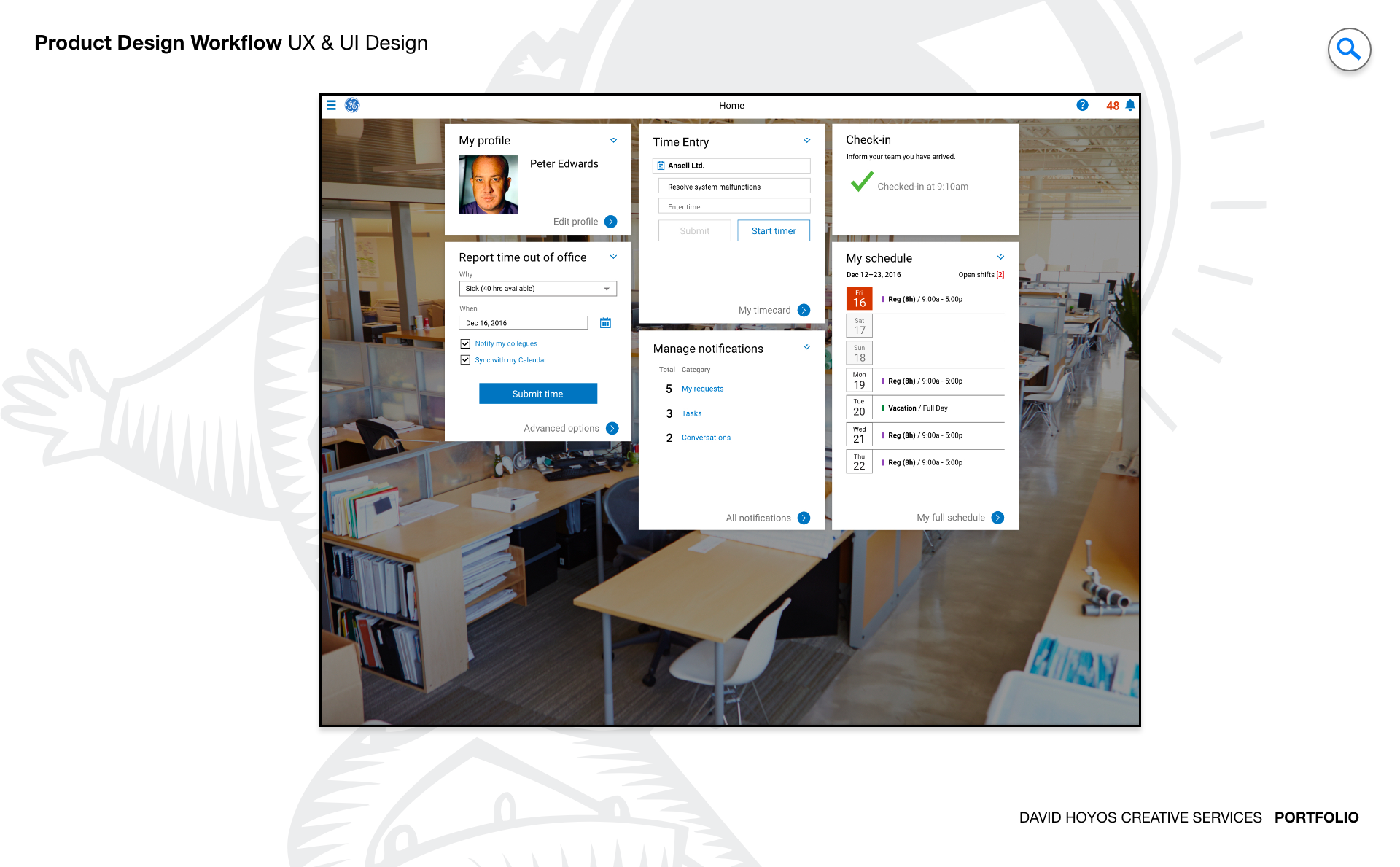
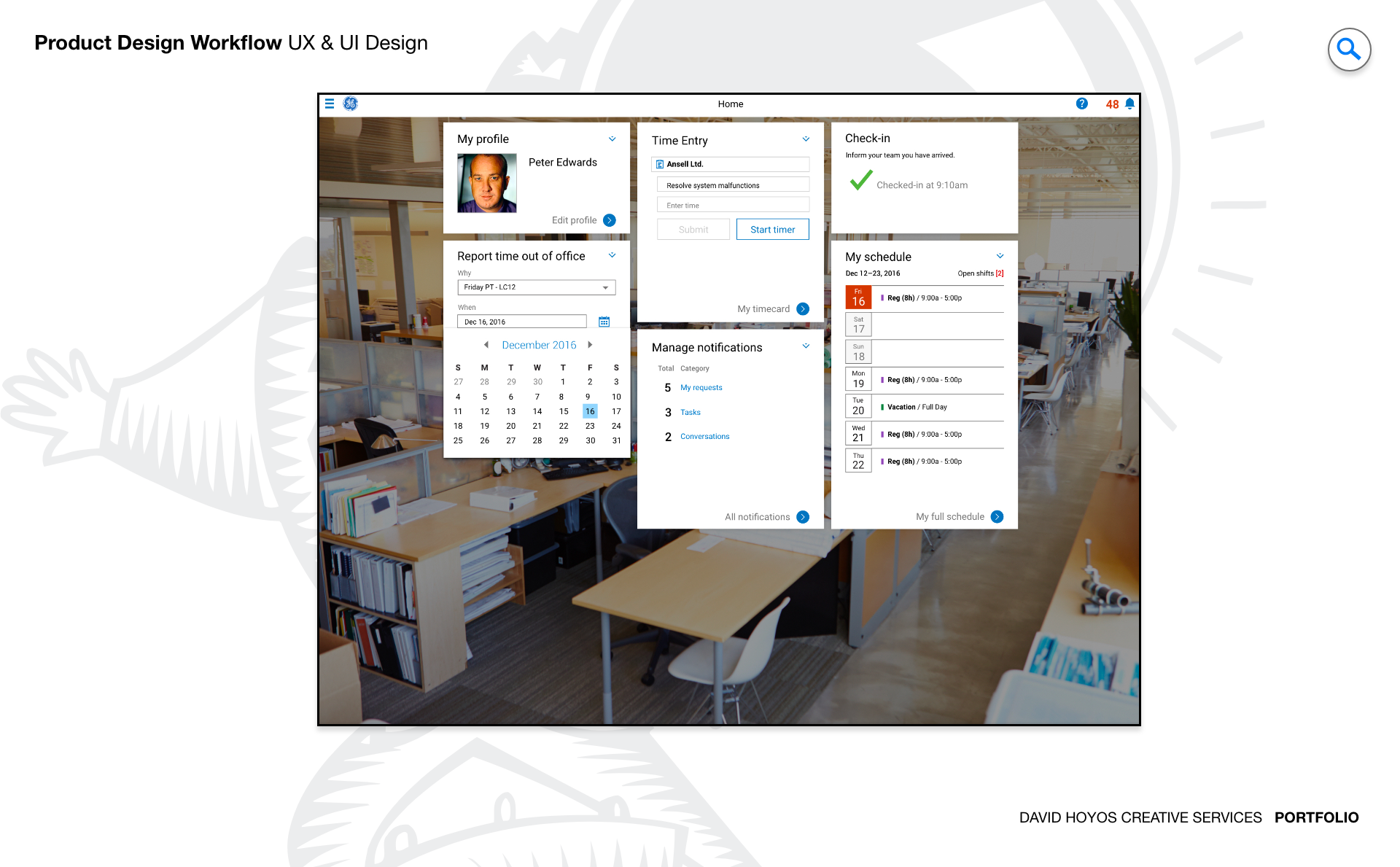
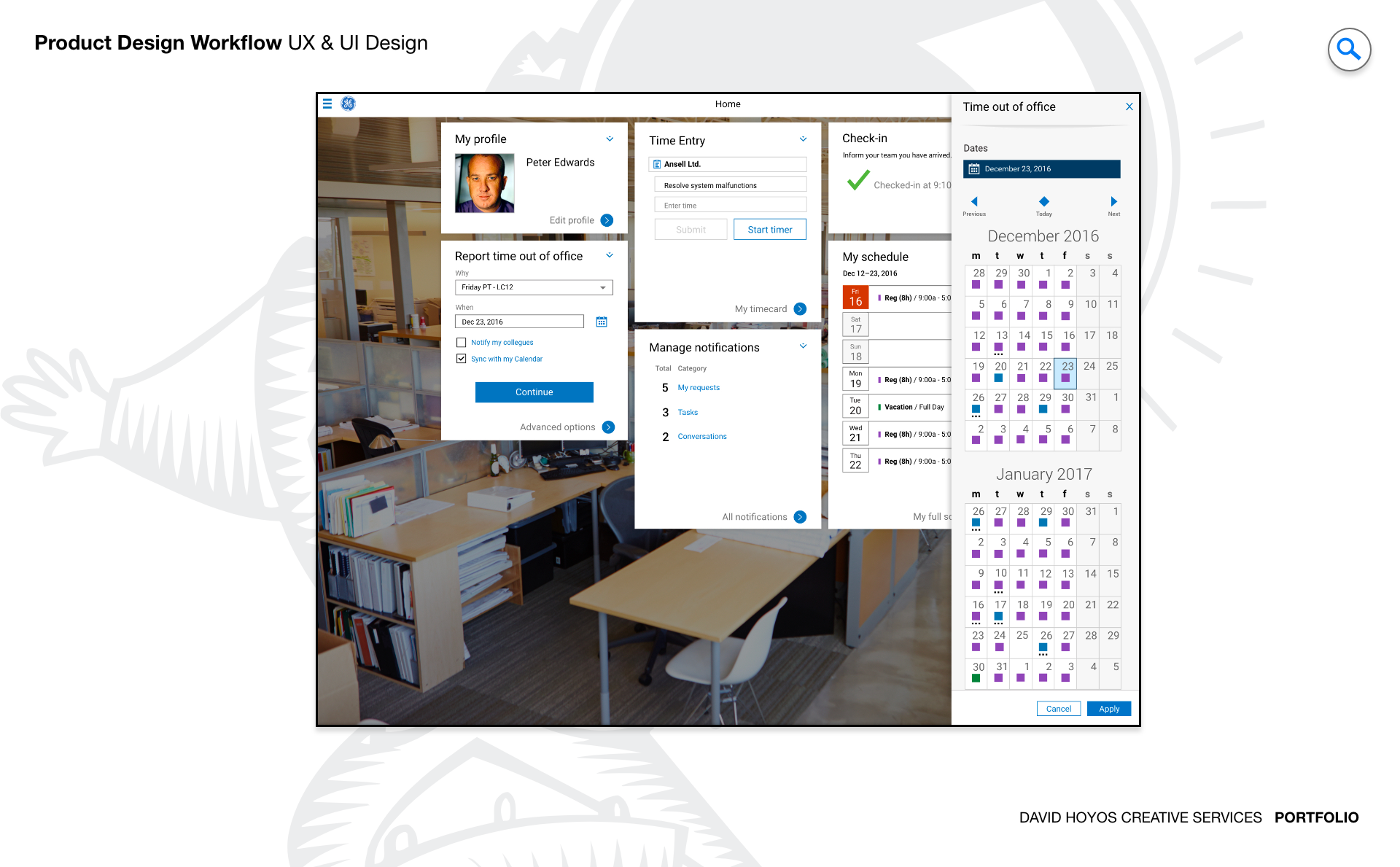
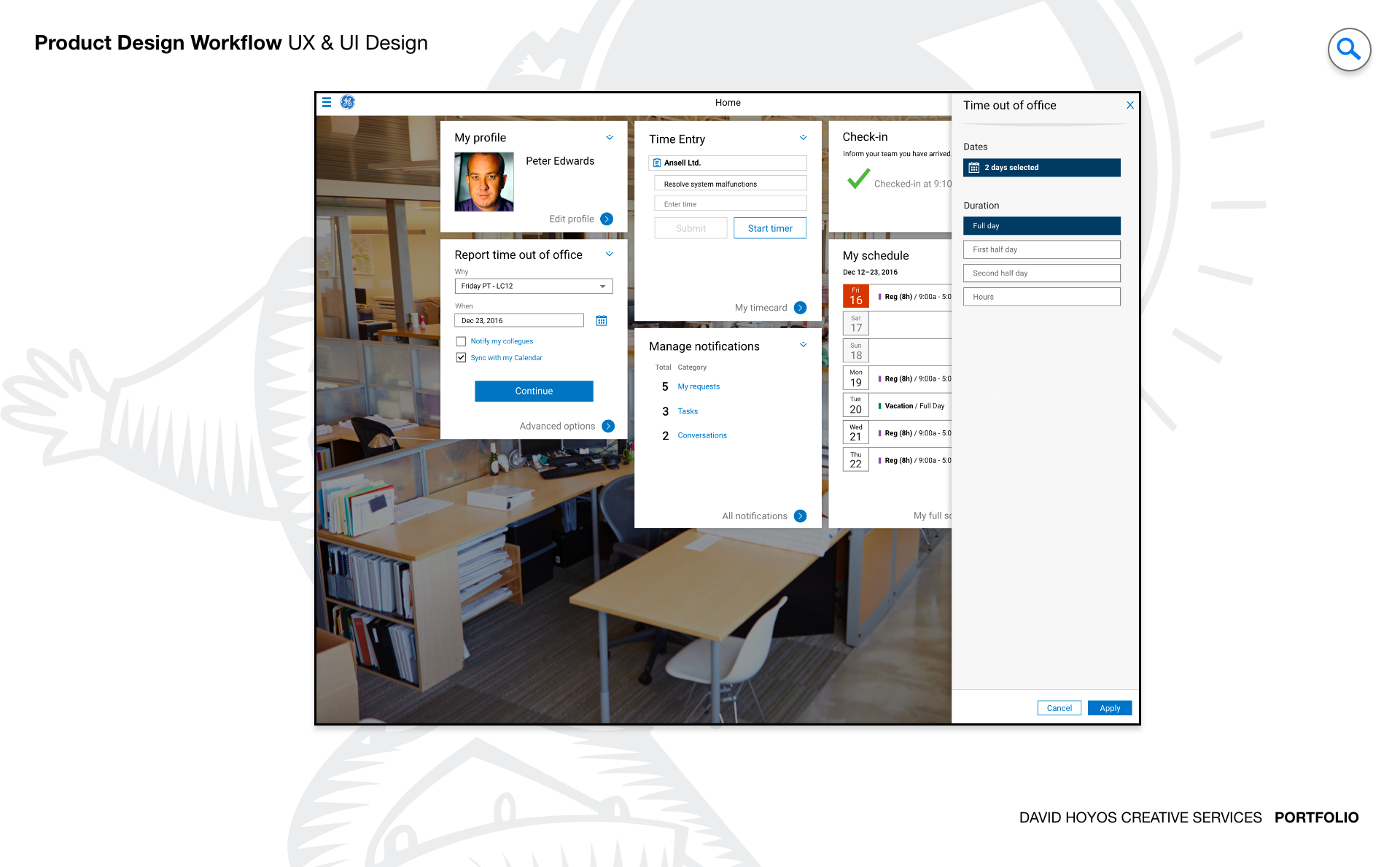
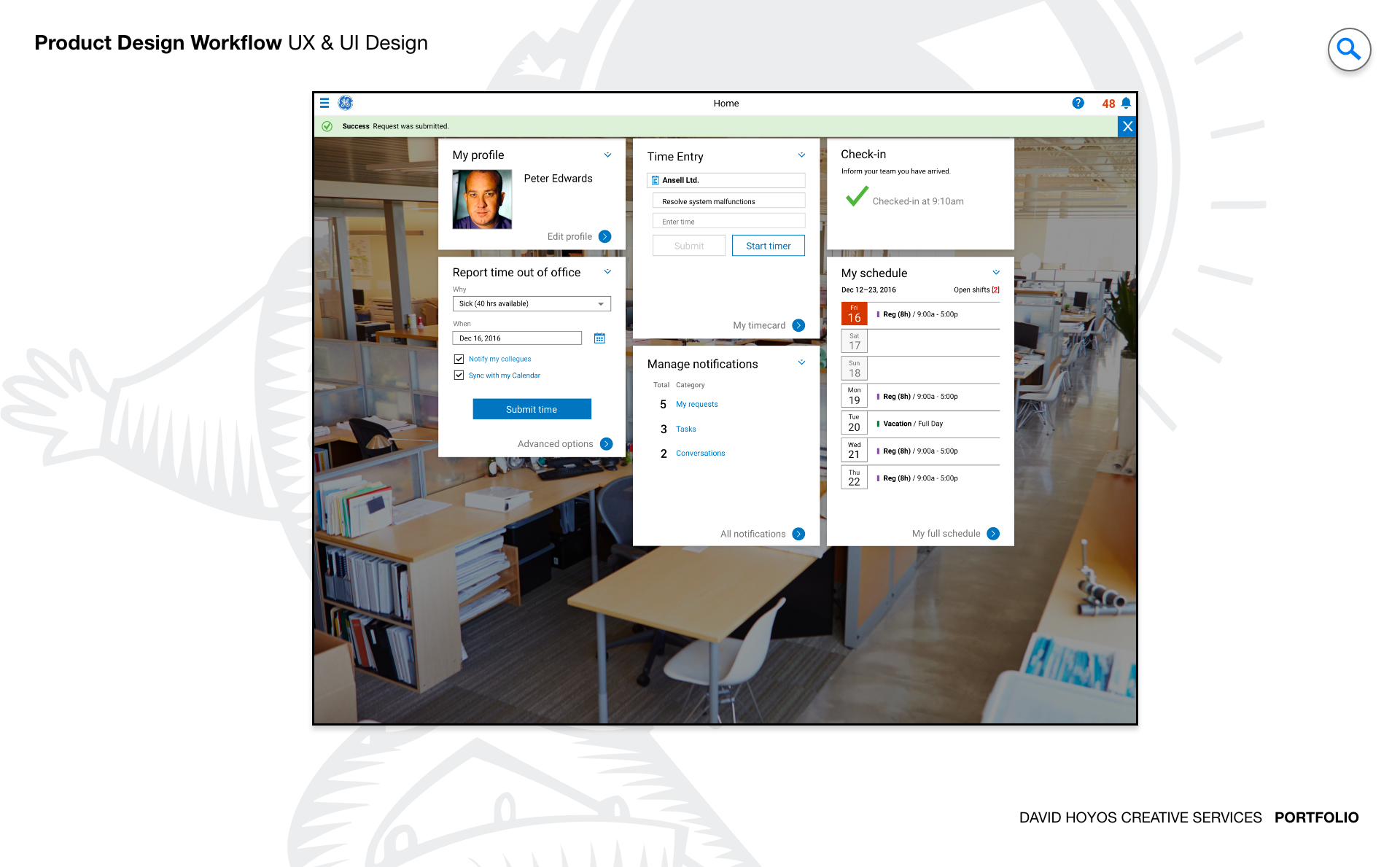
PROJECT Time Off Request / Workflow. Time off is one of the most emotionally significant transactions in the employment relationship. For an employee, submitting a time off request is an act of trust: trust that the system will record the request accurately, that the manager will see it promptly, and that the outcome will be communicated clearly and quickly enough to allow real plans to be made. When that process runs on paper forms, email chains, or fragmented manual systems, it routinely fails all three of those tests. Requests get lost. Managers miss notifications. Approvals arrive days after the employee needed an answer. The Time Off Request Workflow was designed to replace that failure-prone experience with a digital process that was fast, transparent, and reliable from submission to resolution. The workflow lived inside a timekeeping application whose design standard it had to match and whose existing user base it had to serve without disruption. This was not a standalone product but a deeply integrated feature, and the design had to honor that integration at every level: the visual language consistent with the broader timekeeping app, the interaction model familiar to existing users, and the data architecture connected to the scheduling, payroll, and HR systems that needed time off information to function accurately. Designing within those constraints while delivering a genuinely better experience than the processes the workflow replaced was the challenge the creative direction was built around. OBJECTIVE The objective was to design a time off request workflow that eliminated the friction, opacity, and error risk of manual processes by digitizing the full request lifecycle from submission through approval and calendar integration, in a way simple enough for hourly employees to use without training and powerful enough for managers to administer a complex approval hierarchy across a large, multi-role workforce. The two parts of that objective were in productive tension: simplicity for the employee and configurability for the manager pulled in opposite directions, and the design had to hold both without allowing either to compromise the other. Real-time notification was an objective that went beyond the technical requirement of sending alerts. The goal was to create a workflow where no participant ever had to wonder what was happening with a request. Employees knew immediately when their request was received, when it was under review, when it was approved or rejected, and when it was reflected in their schedule. Managers knew immediately when a new request needed their attention, when a request was approaching a response deadline, and when their decision had been communicated to the employee. That level of transparency converted the time off process from a source of anxiety and guesswork into a dependable, low-friction administrative transaction on both sides. Calendar integration and reporting were objectives that served the organization beyond the individual transaction. A time off approval that was not automatically reflected in the scheduling system created a gap between the official record and the operational reality, producing the scheduling conflicts and resource management problems that the workflow was designed to prevent. The comprehensive reporting capability extended the workflow's value to a strategic level: managers and administrators who could see time off patterns across the workforce, identify peak request periods, and model staffing scenarios around historical leave behavior were managers equipped to make genuinely informed resource decisions rather than reactive ones. CHALLENGE Approval hierarchy design was the most structurally complex challenge in the project. Organizations across the four target industries varied enormously in how they structured time off approval: some used flat single-manager approval, others required department head sign-off, others routed requests through HR before managers could act on them, and some used cascading approval chains where a request had to clear multiple levels before it was confirmed. Designing a workflow flexible enough to accommodate all of those structures without requiring each organization to custom-configure the tool from scratch demanded a configuration architecture that was powerful underneath and invisible on the surface. The employee submitting a request should never have experienced the approval hierarchy's complexity. Only the administrators who configured it and the managers who moved through it should have encountered its depth. Compliance with labor law across four industries and multiple jurisdictions was a challenge that touched every feature of the workflow. Leave accrual rules, mandatory sick leave provisions, maximum consecutive vacation day limits, blackout periods, and industry-specific regulations governing what types of leave must be granted under what circumstances varied not just by industry but by state, municipality, and employment classification. The workflow had to be configurable enough to encode those rules accurately for any organization deploying it, enforce them consistently at the point of submission so that employees and managers understood what was and was not approvable before a request entered the approval process, and log the compliance-relevant data in a format that organizations could use to demonstrate adherence in the event of an audit or dispute. Notification design at the right volume and frequency was the third challenge, and it was subtler than it appeared. A workflow that sent every notification it could justify sending created the notification fatigue that caused managers to start ignoring alerts, defeating the transparency objective the real-time system was built to deliver. A workflow that sent too few notifications left participants uncertain about request status, replicating the anxiety the digital system was designed to eliminate. Finding the notification model that kept all participants accurately informed without generating volume that conditioned them to tune it out required careful mapping of which events in the workflow lifecycle genuinely warranted a notification, which could be surfaced through the app interface without an active alert, and which could be batched or summarized to reduce interruption frequency without sacrificing the timeliness of critical status updates. PERSONA(S) Manager, employee. Employee: the persona for whom the time off request process was historically the most opaque and the most frustrating. Employees submitted requests and then waited, often without any indication of when they would hear back or what the status of their request was at any given moment. Making plans around an unanswered request was a gamble, and the emotional cost of that uncertainty was disproportionate to the administrative simplicity of what was being asked. The workflow's employee experience was designed to eliminate that uncertainty completely: from the moment a request was submitted, the employee had a clear, real-time view of its status, knew exactly what action was pending and from whom, and received immediate notification at every stage transition. The submission experience itself was designed around the reality of the hourly employee's working context. Employees in retail, manufacturing, healthcare, and hospitality did not typically submit time off requests while seated at a desk with unhurried attention. They submitted them during breaks, between tasks, or at the end of a shift, often from a mobile device and often under time pressure. The request form had to be fast to complete, unambiguous in its fields, and forgiving of the kind of partial attention that working environments naturally imposed. Every unnecessary field was eliminated, every required field was clearly labeled, and the submission confirmation was immediate and unambiguous so the employee could put the device down knowing the request had been received. Manager: a persona whose relationship with the workflow was defined by the volume of requests they managed and the operational consequences of the decisions they made. Approving a time off request was not an isolated administrative action. It was a decision with downstream effects on scheduling, coverage, and team capacity, and managers making those decisions needed enough context to make them confidently and quickly. The workflow's manager experience surfaced that context at the approval point: the requesting employee's schedule, the team's coverage for the requested period, any overlapping requests from other team members, and the compliance constraints that governed what could and could not be approved, all available without navigating away from the approval interface. The goal was a manager who could act on a request with full information in the time it took to read it. INDUSTRY Retail, manufacturing, healthcare and hospitality. Leave management carries different operational weight in each of the four target industries. In retail, time off requests cluster around predictable peak periods, and the workflow's pattern reporting capabilities gave managers the data to anticipate and plan for those clusters rather than reacting to staffing gaps after they materialized. In manufacturing, where shift coverage is tied to production output and safety staffing requirements, an unapproved absence could have consequences that extended well beyond the individual shift, making the workflow's real-time notification and coverage visibility features operationally critical rather than merely convenient. Healthcare presented the most demanding compliance and coverage requirements of the four industries. Clinical staffing is governed by regulations that mandate minimum coverage levels for patient safety, and time off decisions in healthcare could not be made without direct visibility into how an absence would affect those mandatory ratios. The workflow's coverage modeling and compliance enforcement features were designed with the healthcare context as the highest-stakes test case, producing a system robust enough to meet clinical staffing requirements while remaining usable in the faster-paced, higher-volume request environments of retail and hospitality. An enterprise timekeeping feature that could be trusted in a hospital could be trusted anywhere. PROCESS Assessment + Exploration + Design + Production + Deployment Assessment began with a thorough mapping of how time off requests were currently managed across the four target industries: what the existing processes looked like in practice, where employees and managers experienced the greatest frustration, what compliance requirements each industry imposed, and what the Software Architect identified as the technical constraints governing how the workflow could integrate with the existing timekeeping infrastructure and the calendar, scheduling, and HR systems it needed to communicate with. That mapping produced a precise design brief: a prioritized list of the user experience problems the workflow had to solve, the compliance requirements it had to satisfy, and the technical constraints it had to work within from the first design decision. Exploration developed and tested the approval hierarchy model, the notification framework, and the submission and review interfaces against real user behavior, working through how different organizational structures would configure the hierarchy, how managers in time-pressured environments interacted with pending requests, and how employees across the persona spectrum responded to the submission form and status communication design. Design, Production, and Deployment built the full high-fidelity experience and BuildKit from the tested Exploration foundation, with the Software Architect's continuous involvement ensuring the implemented workflow integrated accurately with the timekeeping application's data layer and the downstream systems that depended on it for accurate scheduling and payroll information. DELIVERABLES Wires, High-Fidelities, BuildKit (specs). Wireframes mapped the complete request lifecycle across every participant and every workflow state: the employee submission flow across leave types, the manager approval interface with its coverage and compliance context, the multi-level approval routing for organizations with complex hierarchies, the calendar integration confirmation, the notification trigger points and their content logic, the reporting dashboard, and the administrator configuration interface for encoding organization-specific approval structures and compliance rules. Because the workflow was a deeply integrated feature within an existing timekeeping application, the wireframes also documented how the new feature connected to an extended existing application screens rather than treating it as a standalone experience. High-fidelity designs delivered the complete visual expression of the workflow within the timekeeping application's established design language: every submission form state, every approval interface configuration, every notification template, every calendar integration confirmation, and every reporting view rendered at the fidelity required to build from directly. The designs resolved the tension between the employee's need for simplicity and the manager's need for depth into a coherent visual hierarchy that served both without compromise. The BuildKit provided the complete implementation specification: component library documentation, interaction state diagrams, notification content and trigger specifications, compliance rule configuration logic, integration data model documentation, and responsive layout rules, giving the Software Architect and front-end developer everything they needed to build the workflow exactly as designed across every deployment context. TEAM UX + UI + Research + Front-end Developer + Software Architect + PM UX, UI, Research, a Front-end Developer, a Software Architect, and Product Management. The Software Architect's role was foundational on a workflow feature where the design's most important promises, real-time notifications, automatic calendar integration, and compliance rule enforcement at the point of submission, were all dependent on backend capabilities that had to be scoped and committed to before the design could finalize the experiences built on top of them. That early architectural involvement meant the notification model, the integration touchpoints, and the compliance configuration framework were designed with full knowledge of what the system could reliably deliver, producing commitments to users that the implementation could keep. Research validated the submission form design, the approval interface's contextual information model, and the notification framework against the real behavior of managers and employees in each of the four target industries, ensuring the workflow's design reflected how people actually managed time off requests in their working contexts rather than how they might manage them in ideal conditions. The front-end developer's involvement during design kept the interface specifications within the implementation capabilities of the timekeeping application's existing technical stack, preventing the design from introducing approaches that would require significant infrastructure work to support. Product Management maintained alignment between the workflow's design and the broader product roadmap, ensuring the feature advanced the timekeeping application's competitive position across all four target industries while integrating cleanly with the existing feature set. ROLE Creative and design direction (UX/UI). Creative and design direction across UX and UI for the full scope of the Time Off Request Workflow. At the creative direction level, the role required establishing the design vision for a feature whose success depended on resolving a fundamental tension: the employee's need for an experience simple enough to use without thought and the manager's need for an experience deep enough to support consequential workforce decisions. Setting the design direction for that tension meant establishing the principle that governed it: simplicity at the surface, depth accessible through deliberate navigation, and the visual hierarchy that made the distinction between the two immediately legible to every user type without requiring instruction. The compliance dimension of the project gave the creative direction an unusually concrete responsibility. Every design decision that touched how compliance rules were surfaced to employees and managers at the point of submission was a decision with legal implications, not just UX implications. Directing how the workflow communicated what was and was not permissible under each organization's configured rules, in language clear enough to prevent confusion without being legalistic enough to create anxiety, was a design challenge that required the same precision as the visual and interaction work. Maintaining that standard across the full feature scope, from the submission form through the approval interface to the reporting dashboard, was the dimension of the creative direction that most directly reflected the professional stakes of the product being designed.