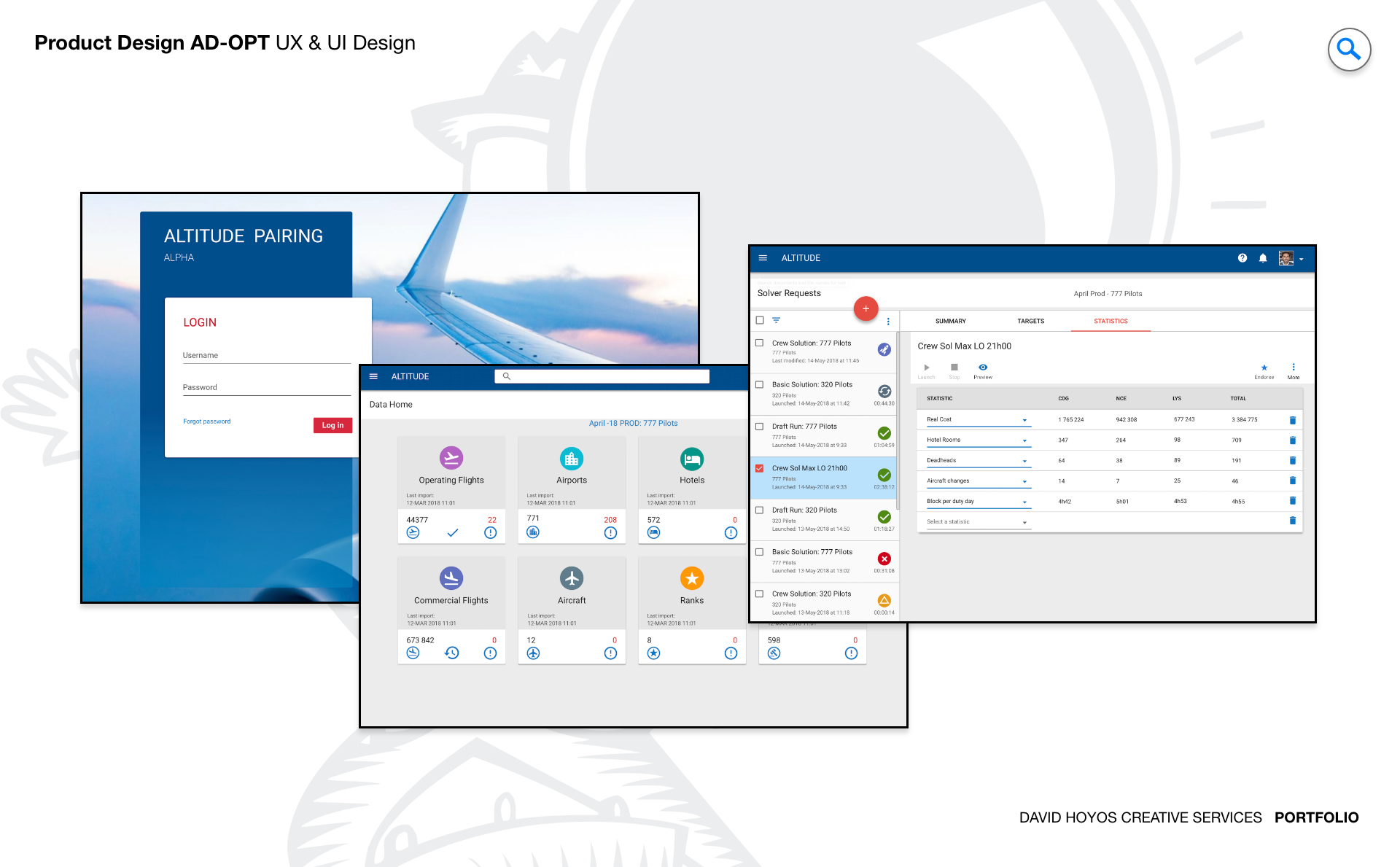
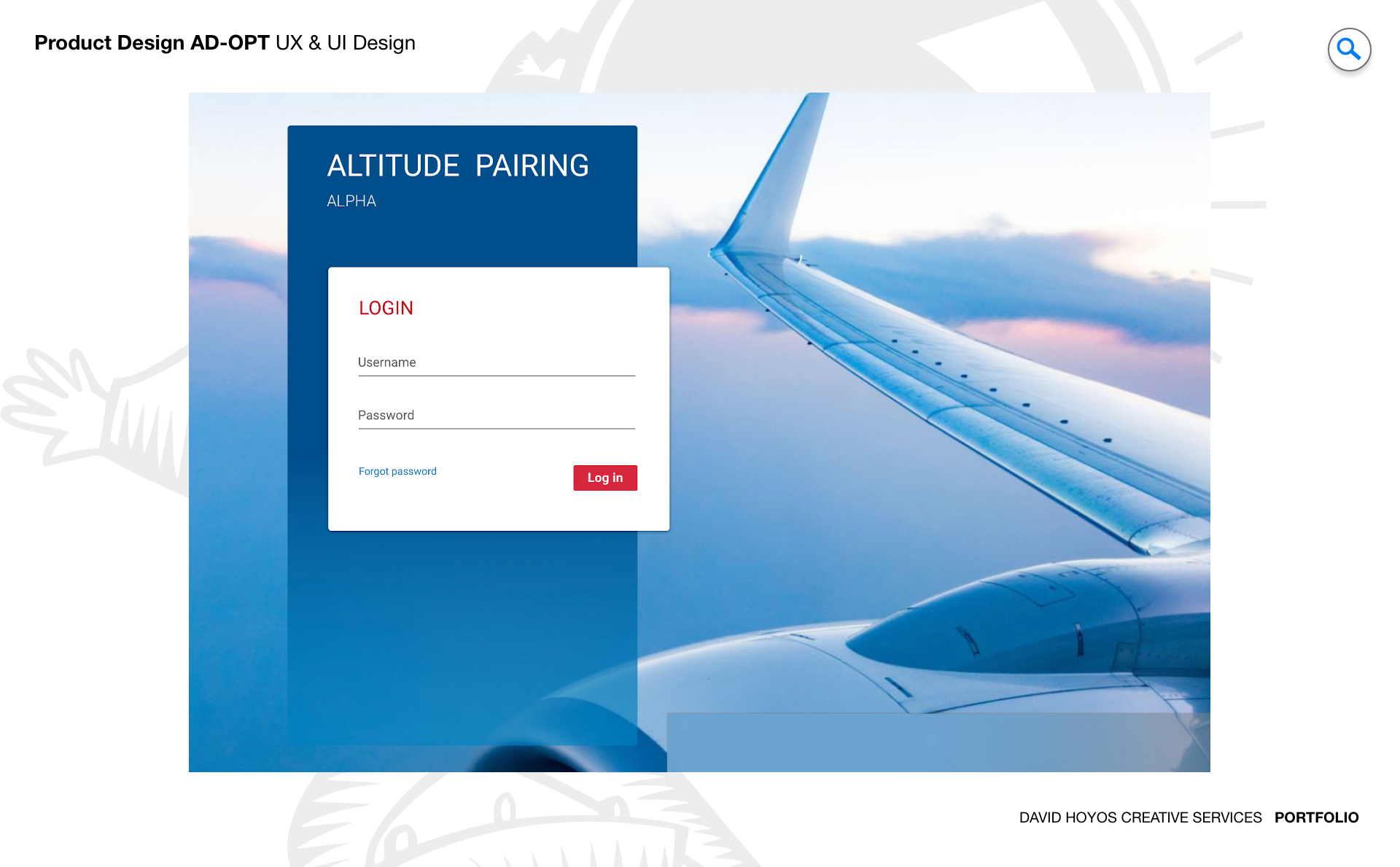
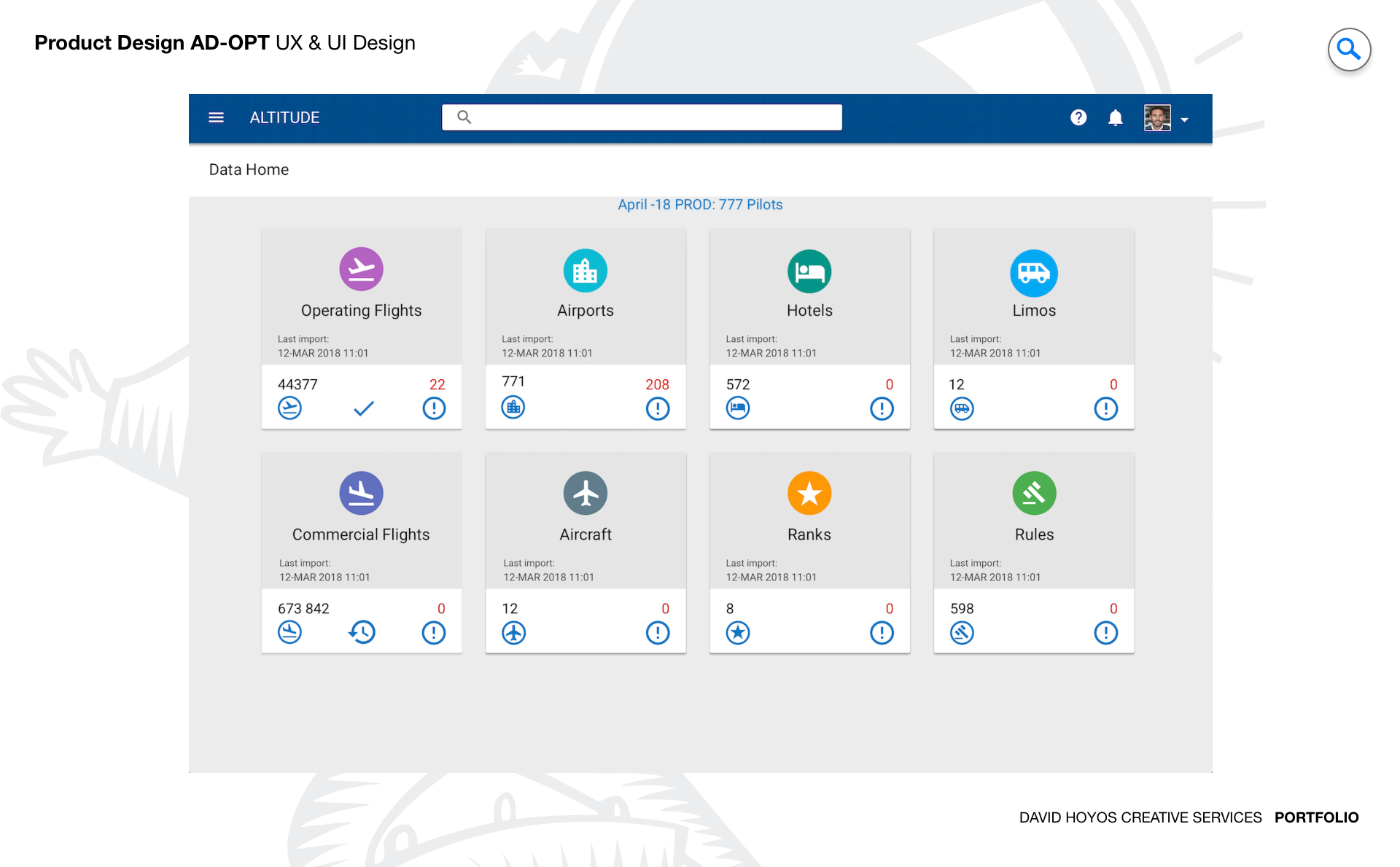
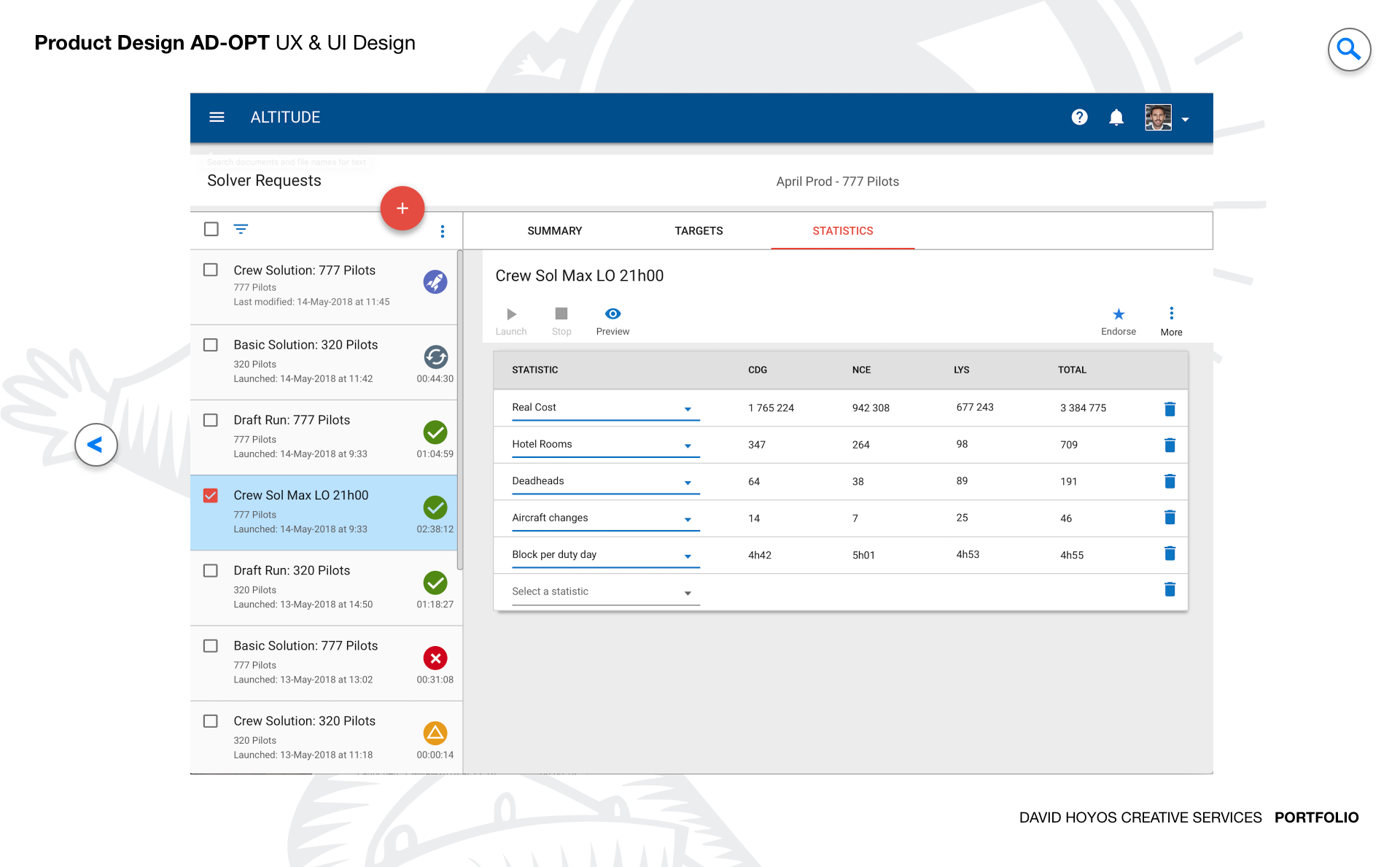
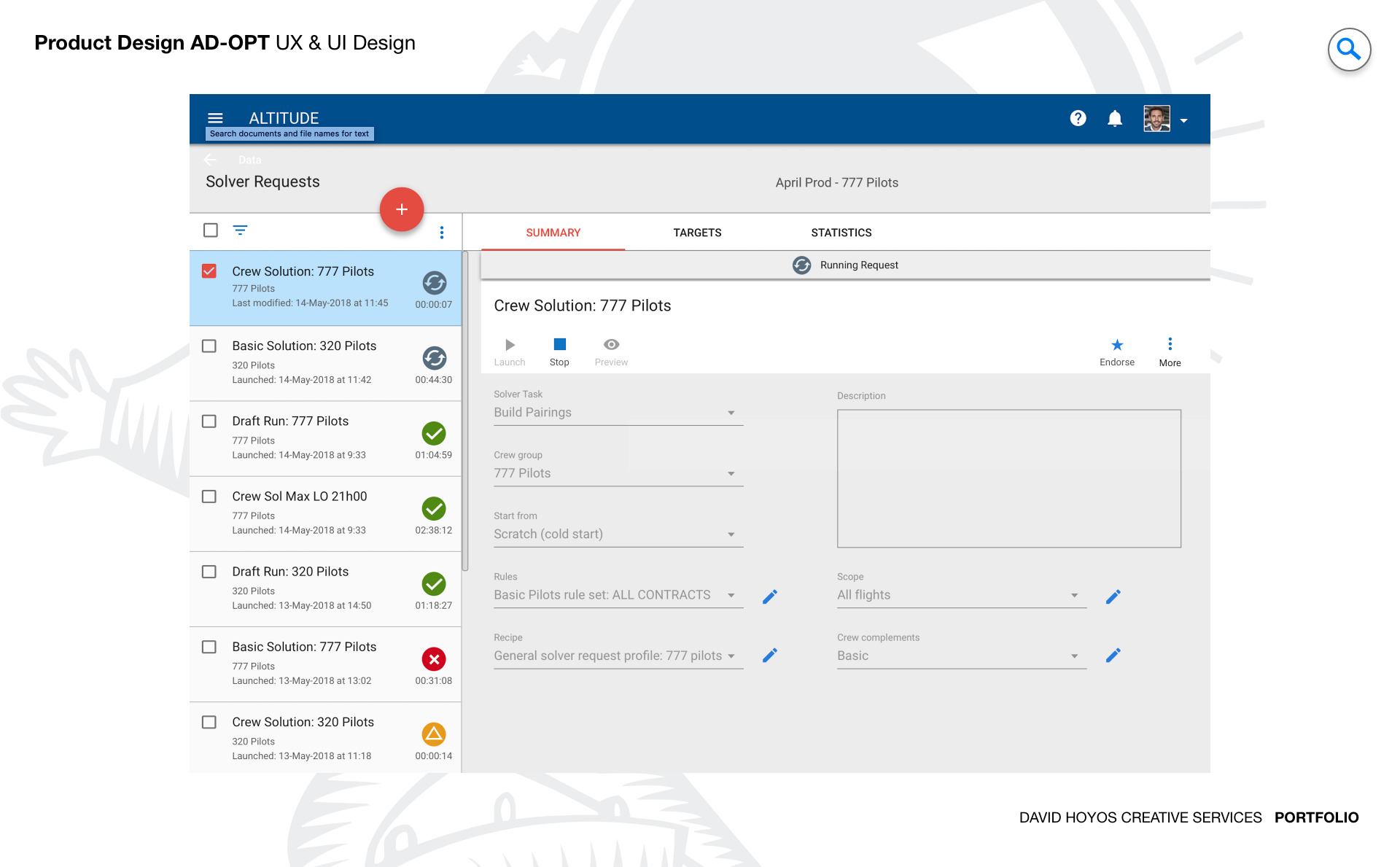
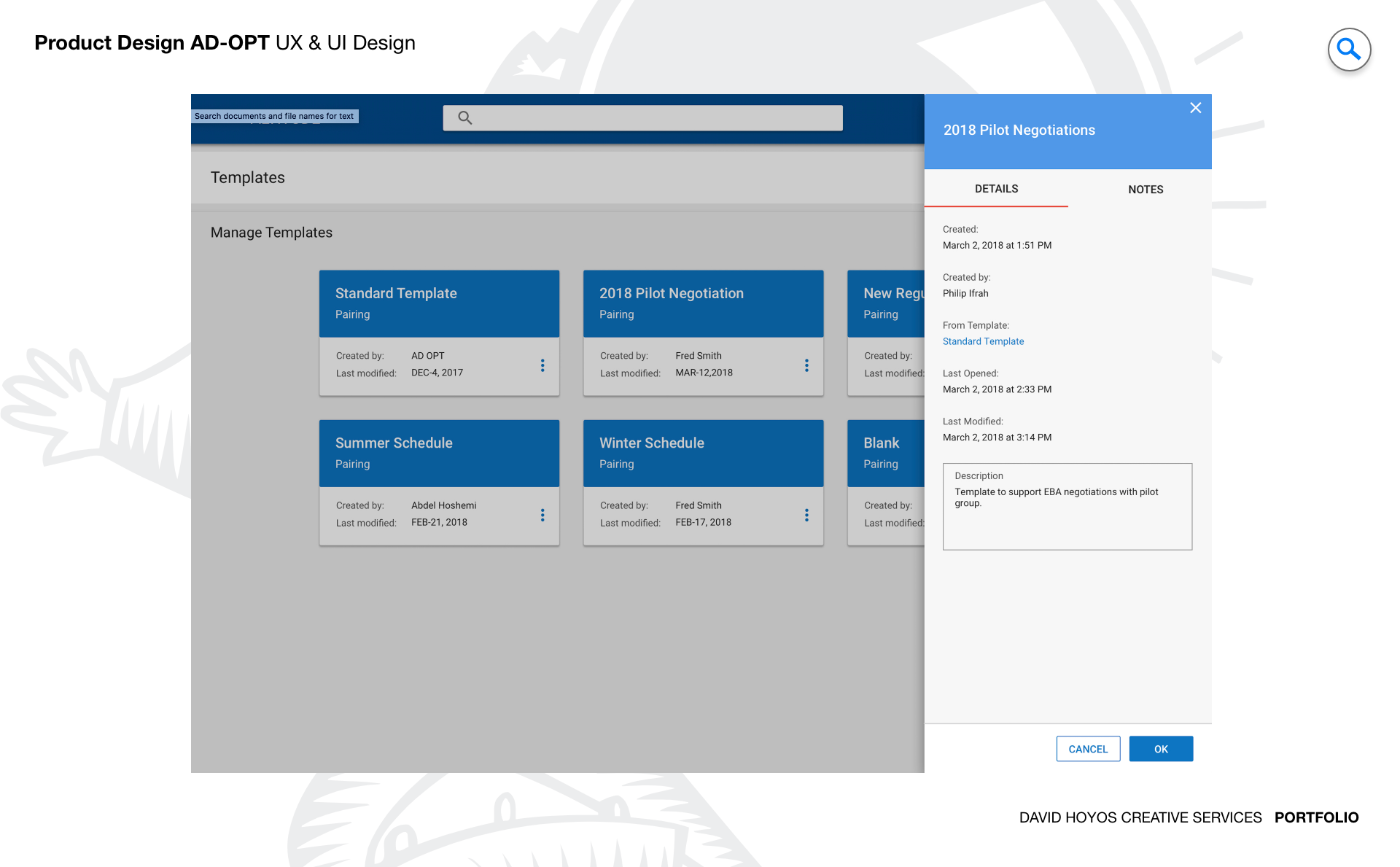
PROJECT Ad-Opt Web Application. Airline crew scheduling is one of the most constrained optimization problems in enterprise software. Every assignment involves a pilot or crew member whose qualifications must match the aircraft type, whose duty hours must comply with federal rest and flight time regulations, whose union contract may impose additional restrictions on top of those regulations, and whose existing schedule may already have commitments that limit availability across the scheduling window. Multiply that across hundreds or thousands of crew members operating dozens of aircraft across a network of routes that changes daily based on demand, weather, and mechanical availability, and the scale of the problem becomes clear. Ad-Opt was designed to bring automated intelligence and a precision-built user interface to that problem, giving scheduling supervisors and system administrators the tools to manage it with a level of efficiency and reliability that manual processes and legacy scheduling systems could not approach. The stakes in airline scheduling are not merely operational. Flight time limitation regulations exist because crew fatigue has been a documented factor in aviation accidents, and the consequences of a scheduling error that puts a fatigued crew on an aircraft are categorically different from the consequences of a scheduling error in any other industry. Ad-Opt was designed with that weight built into every layer of the product, from the automated compliance checks embedded in the schedule generation algorithm to the visual design of the supervisor interface, which surfaced regulatory risk signals at a glance rather than burying them in data. The goal was not just a more efficient scheduling tool but a safer one. OBJECTIVE The objective was to design a web application that automated the generation of optimized pilot and crew schedules for airline operations while giving supervisors and system administrators the interface control to oversee, adjust, and manage those schedules with full situational awareness in real time. The automation objective was measured not by how much of the scheduling process it could replace but by how much better it made the decisions that human supervisors still needed to make. A fully automated schedule that supervisors could not understand, interrogate, or confidently override was not a better scheduling tool. It was a black box that shifted risk from the scheduling team to the algorithm. Real-time disruption management was an objective as demanding as initial schedule generation. An airline's schedule at 06:00 is not the same schedule it is operating at 14:00. Weather events ground aircraft. Mechanical issues pull crew members off flights. Illness removes crew from availability without warning. Each disruption cascades through a schedule built on interconnected dependencies, and the response to each one required the same compliance checks, qualification matching, and constraint validation as the original schedule generation, executed in a fraction of the time. The application's real-time update architecture and its supervisor interface were designed to make disruption response fast enough to keep operations moving and accurate enough to keep them compliant. Integration with the airline's existing technology ecosystem was an objective that determined how much value Ad-Opt could deliver in practice. A scheduling tool that operated in isolation from crew management systems, aircraft scheduling databases, and payroll systems created data synchronization problems that consumed the administrative time the automation was meant to save. The integration architecture was designed to make Ad-Opt a connected component within the airline's operational technology stack, receiving data from upstream systems and providing schedule outputs to downstream systems in formats that required no manual translation or re-entry. That connectivity was what converted Ad-Opt from a better scheduling interface into a genuine operational platform. CHALLENGE Regulatory and contractual compliance at the design level was the challenge that distinguished airline crew scheduling from every other workforce scheduling problem. Federal Aviation Administration flight time limitation regulations, European Union Aviation Safety Agency equivalent standards for international carriers, and the additional restrictions encoded in each airline's union contracts collectively produced a compliance rule set of significant complexity that had to be enforced automatically at every point where a schedule assignment was created or modified. Designing the compliance architecture, which was both the automated enforcement layer in the algorithm and the visual communication layer in the supervisor interface, required a deep understanding of those rules and the ability to translate them into design patterns that made violations immediately visible and prevented them from being committed inadvertently rather than relying on supervisors to catch them manually. Information density at the supervisor interface was the UX challenge that the problem's inherent complexity made unavoidable. A crew scheduling view that displayed one crew member's assignment at a time was too narrow to support the pattern recognition that experienced supervisors relied on to identify coverage gaps, optimization opportunities, and cascading disruption effects across a network. A view that displayed all crew members across a full scheduling window simultaneously was too dense to be actionable. Designing the interface to find and hold the productive middle ground, enough information to support pattern recognition without so much that the signal disappeared into visual noise, required iterative work with supervisors whose expertise in reading scheduling data was the standard the design had to meet. Scalability at the design level extended beyond the standard performance engineering requirement. A scheduling application designed for a regional carrier with a small fleet and a manageable crew roster had to function with equal reliability for a major international carrier whose scheduling operations involved thousands of crew members, dozens of aircraft types, and route networks spanning multiple continents and time zones. The interface architecture, the data model displayed to supervisors, and the analytics and reporting system all had to be designed to remain coherent and actionable at the largest scale the application would encounter, without requiring different design patterns for different airline sizes. That design scalability, distinct from but closely related to the technical scalability of the underlying system, was a requirement that ran through every design decision on the project. PERSONA(S) Supervisor, System Admin. Scheduling Supervisor: a domain expert whose professional judgment was the final check on every schedule the application produced. Supervisors in airline crew scheduling carried institutional knowledge about their crew base, their aircraft fleet, and their route network that no algorithm fully encoded: the experienced first officer who performed better on long-haul international routes, the crew pairing that historically generated high-quality flight operations, the regulatory edge cases that the compliance rule set technically permitted but operational experience had shown were better avoided. The interface had to support that expert judgment rather than present the algorithm's output as final, giving supervisors clear visibility into the schedule's logic, efficient tools for interrogating and modifying specific assignments, and enough contextual information at the decision point to make informed overrides confidently and quickly. The supervisor's relationship with the application changed character dramatically during disruption events. In routine schedule management, supervisors worked with time to evaluate options, run alternative scenarios, and make deliberate decisions. During a disruption, they were working against an operational clock measured in minutes, making rapid decisions with significant downstream consequences while simultaneously managing communication with crew members, ground operations, and passengers. The disruption management interface was designed specifically for that pressure context: a tighter information surface optimized for speed, automated constraint checking that ran in the background rather than requiring manual validation steps, and a clear visual language that distinguished the most urgent decisions from those that could be deferred without operational consequence. System Administrator: the persona responsible for configuring and maintaining the rule set that made the application's automation trustworthy. System administrators translated federal regulations, union agreements, and airline-specific policies into the configuration parameters that governed the schedule generation algorithm and the compliance enforcement layer. That work required a configuration interface of significant depth, capable of encoding rules with the precision and specificity that aviation regulatory compliance demanded, while remaining navigable enough that administrators could locate, understand, and modify specific rules without consulting documentation every time a regulatory change required a configuration update. The administrator's interface was where the application's compliance promise was either made good or broken, and it received design attention proportional to that responsibility. INDUSTRY Airspace The airline industry operates a scheduling environment with no direct parallel in other workforce management domains. The combination of federal safety regulation, union contract complexity, aircraft type qualification requirements, international route time zone management, and the 24-hour continuous operational rhythm of a major carrier produced a scheduling problem whose solution required purpose-built tools rather than adapted versions of workforce management software designed for other industries. Ad-Opt was designed from the ground up for this specific context, with a data model, a compliance architecture, and an interface design that reflected the actual structure of airline crew scheduling rather than a generalized scheduling framework applied to an aviation use case. Aviation's safety culture permeated the design requirements in ways that had no equivalent in commercial or industrial workforce scheduling. The principle that safety-critical information must be impossible to miss, impossible to misread, and impossible to dismiss without deliberate acknowledgment governed the design of every compliance signal in the supervisor interface. Color, typography, visual hierarchy, and notification behavior were all calibrated to meet that standard, producing an interface where the visual design of regulatory risk was not an aesthetic choice but a safety engineering decision. Designing within that standard, while still producing an interface that experienced supervisors found efficient and usable rather than visually alarmist, was one of the defining creative challenges of the project. PROCESS Assessment + Exploration + Design + Production + Deployment. Assessment was the longest and most research-intensive phase of the project, because the domain complexity of airline crew scheduling required genuine expertise to design for and that expertise lived entirely in the minds of the supervisors and system administrators who would use the application. Assessment involved extended observation and interview sessions with scheduling supervisors across different airline sizes and operational models, mapping the actual workflow of schedule generation and disruption management in enough detail to understand where the existing tools and processes failed and what the application needed to do differently. The regulatory compliance framework was documented in parallel, working with airline compliance and legal teams to understand the full scope of the rules the application's automation had to enforce. Exploration tested the supervisor interface design against the complexity of real scheduling scenarios, working through how the schedule visualization, the assignment controls, the compliance signal system, and the disruption management interface performed under the kinds of operational pressure that supervisors actually experienced. The Software Architect's involvement during exploration was essential for scoping the real-time update architecture and the integration framework, ensuring the interface design was built on a technically accurate understanding of what the system could deliver within the performance requirements of live airline operations. Design, Production, and Deployment completed the cycle, producing the full high-fidelity experience and BuildKit from the tested and validated exploration direction, with the compliance enforcement layer and the integration specifications documented in the BuildKit with the precision that aviation-grade implementation required. DELIVERABLES Wires, High-Fidelities, BuildKit (specs). Wireframes resolved the structural architecture of the full application before any visual design investment was made: the schedule visualization and its density calibration across different view scales, the assignment and override controls, the compliance signal hierarchy and its placement within the supervisor interface, the real-time notification and disruption alert system, the analytics and reporting dashboard, the system administrator configuration interface, and the integration management screens. Because the application's complexity was genuine and extensive, the wire phase included detailed interaction documentation for the non-obvious workflows, particularly the disruption response sequence and the multi-constraint schedule modification flow, where the interaction logic was as important to get right as the visual layout. High-fidelity designs delivered the complete visual system for Ad-Opt: a modern, precision-oriented interface language that communicated the application's authority and reliability, with the visual hierarchy and compliance signal design that the aviation safety standard required, applied across the full scope of the supervisor and administrator experiences. The designs resolved the information density challenge into a coherent visual system where the most operationally critical information was always prominent and the deeper data layers were accessible through deliberate navigation that did not crowd the primary decision-making surface. The BuildKit provided the complete implementation specification, with particular depth on the compliance signal component library, the real-time update state model, the integration data exchange specifications, and the performance requirements that governed how the front-end rendered schedule data at the scale of a major carrier's full crew roster. TEAM Research, a Front-end Developer, a Software Architect, and Product Management. The Software Architect's role on Ad-Opt was more deeply integrated into the creative direction work than on most projects, because the application's most important design decisions were inseparable from architectural commitments: how real-time schedule updates were delivered to the interface, how the compliance enforcement layer communicated its results to the supervisor, and how the integration framework connected Ad-Opt to external airline systems all had design dimensions that the creative direction had to understand and work within accurately. The Software Architect was the partner who made that understanding possible and who ensured the design direction was anchored in technical reality throughout. Research was the foundation of the entire project in a domain where the cost of designing from assumption rather than observation was particularly high. Airline scheduling supervisors possessed expertise developed over years of experience with specific regulatory frameworks, specific fleet characteristics, and specific crew bases, and that expertise was the design brief's most important input. The research team's work translating that expertise into design requirements was what made it possible to design an interface that experienced supervisors found genuinely useful rather than dismissible as a tool built by people who did not understand the problem. Product Management maintained alignment between the design direction and the commercial requirements of the airline industry market, ensuring Ad-Opt's design positioned the product competitively across the airline size spectrum from regional carriers through major international operators. ROLE Creative and design direction (UX/UI). Creative and design direction across UX and UI for the full scope of the Ad-Opt web application. At the creative direction level, the role required establishing the design vision for a product operating in a domain where the complexity of the underlying problem and the safety stakes of the decisions made within the interface set a uniquely demanding standard for what the design had to achieve. Setting that vision meant defining not just what the application looked like but what it stood for: precision without intimidation, authority without opacity, and the kind of operational confidence that a scheduling supervisor needed to trust their tool under the pressure conditions of live airline operations. The compliance signal design was the dimension of the creative direction that carried the greatest responsibility. In a safety-critical industry, the way the interface communicated regulatory risk was not an aesthetic decision but a design decision with safety implications. Directing the visual language of compliance signals, the hierarchy of alert severity, the behavior of enforcement notifications, and the way the system distinguished between hard regulatory violations and softer operational warnings required the same precision and deliberateness as any structural design decision on the project. Ensuring that system was coherent, unambiguous, and impossible to misread under operational pressure conditions was the creative direction contribution that most directly reflected the stakes of the domain the application was built to serve.