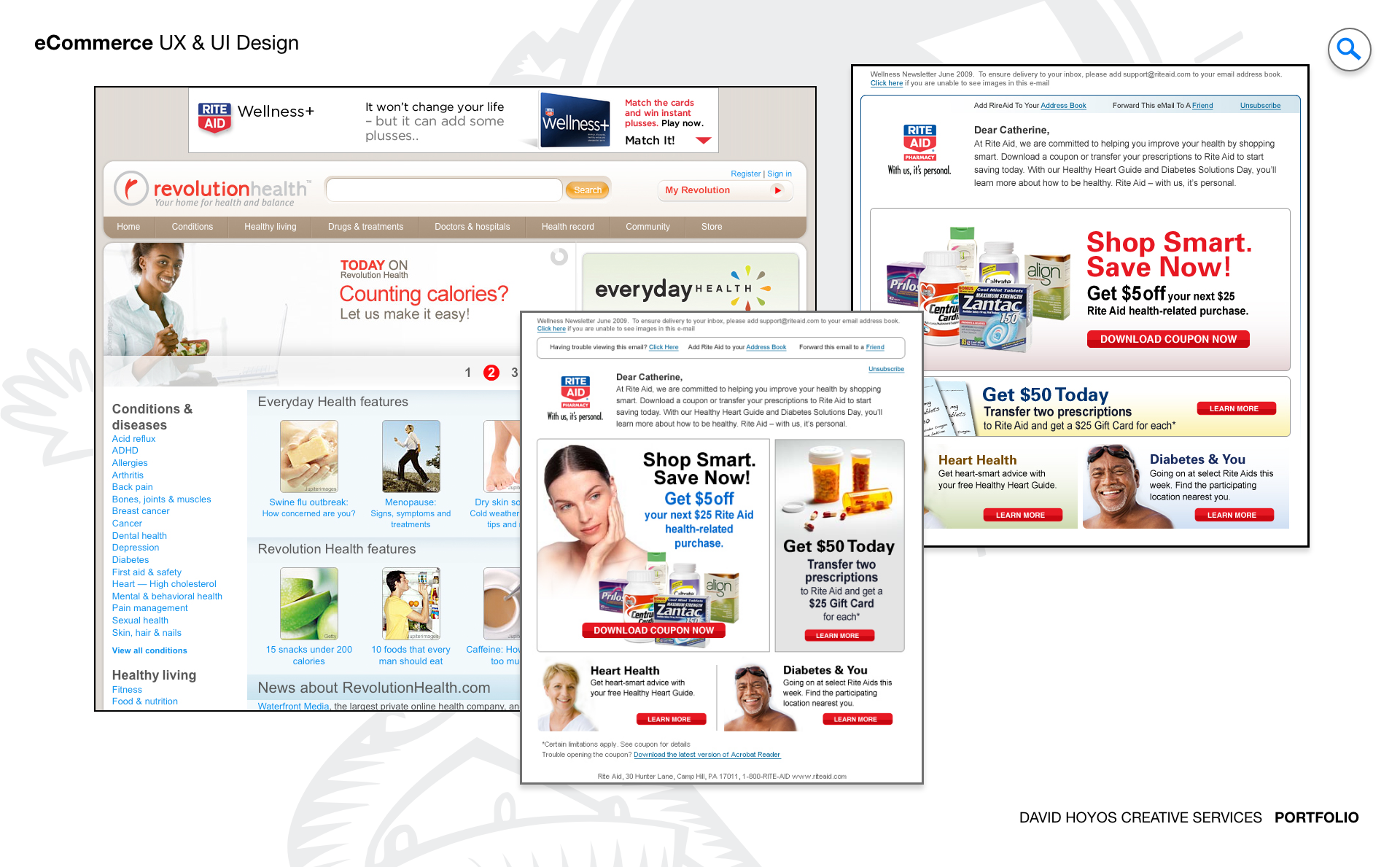
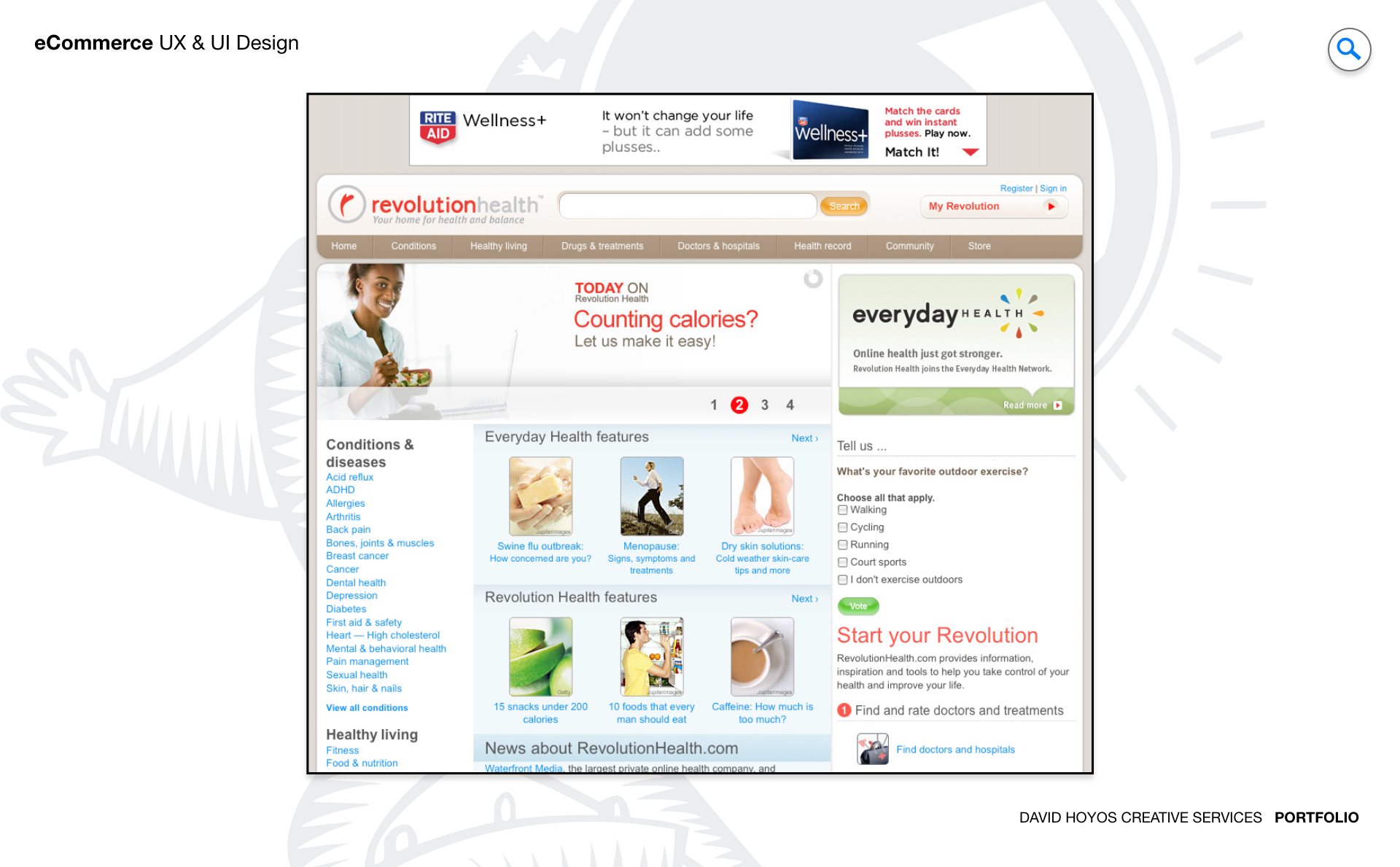
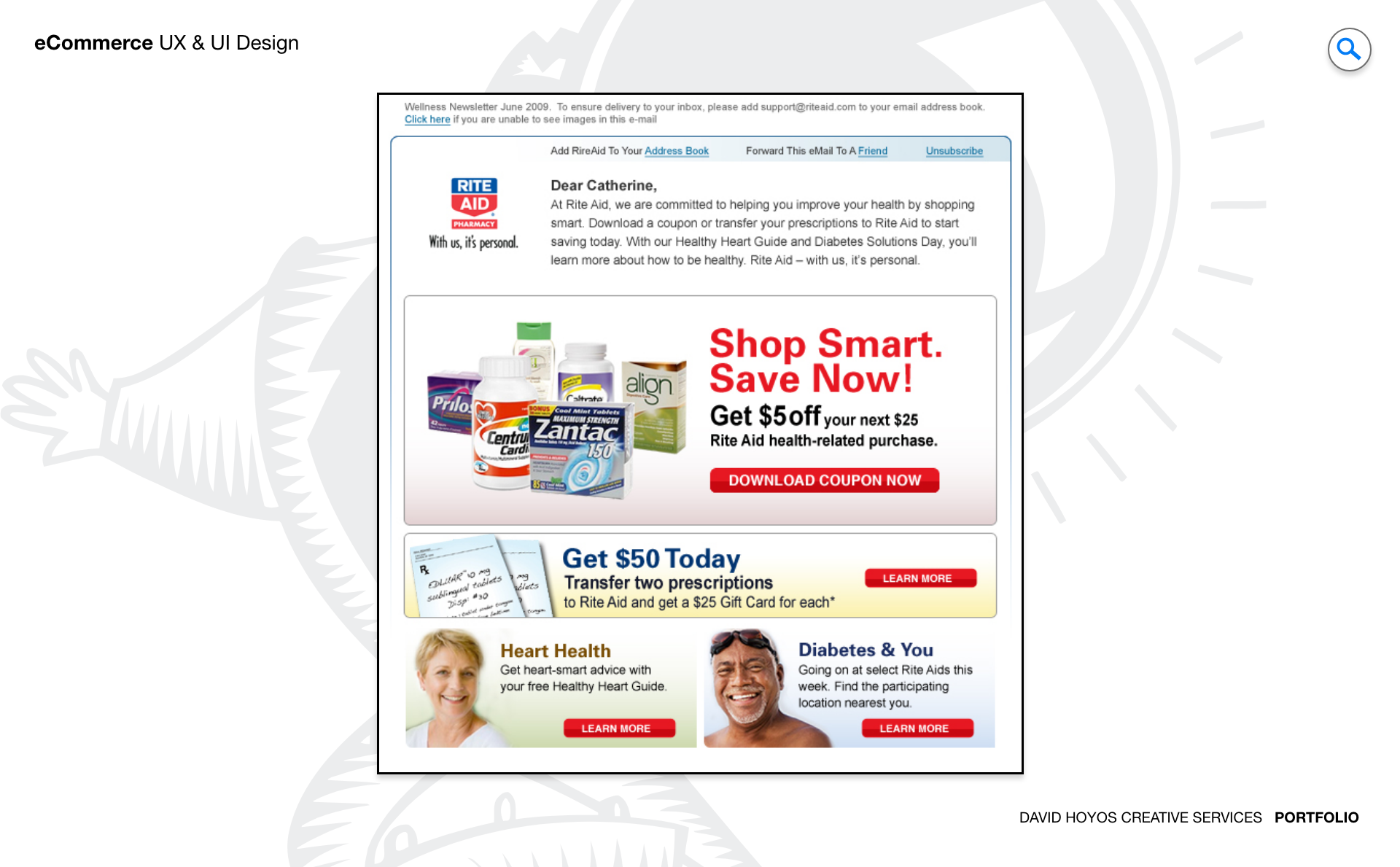
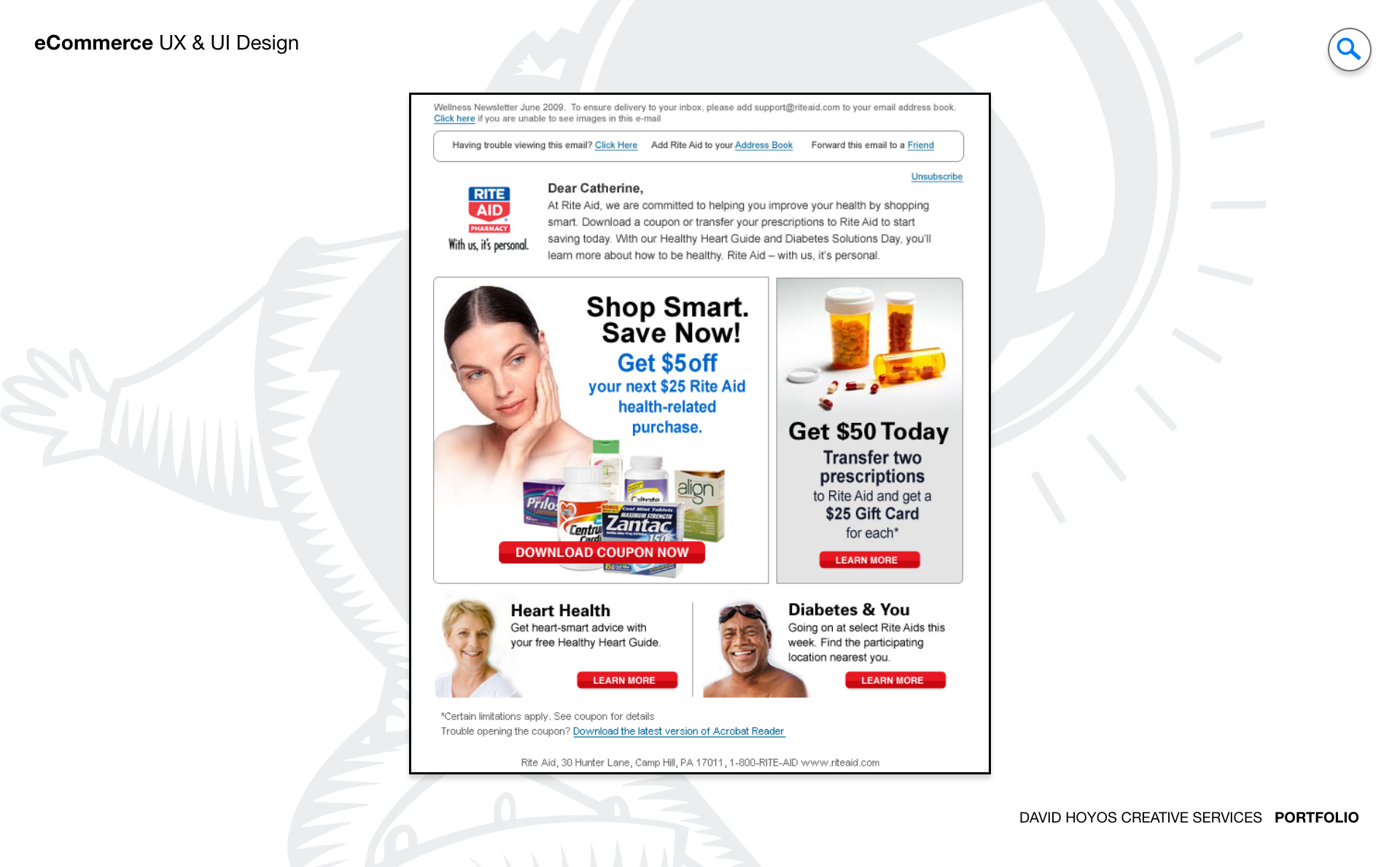
PROJECT Rite Aid Website (B2C). Few retail brands carry as much daily trust as a pharmacy chain. Rite Aid sits inside millions of people's most personal routines: picking up a prescription, managing a chronic condition, stocking a medicine cabinet, buying products for a newborn or an aging parent. The digital presence that brand puts forward either reinforces that trust or quietly erodes it. An outdated, fragmented, or hard-to-navigate website tells customers that their time and wellbeing are not priorities. A well-designed one tells them exactly the opposite. This project was about building the latter: a fully branded, end-to-end e-commerce portal that made every interaction feel as reliable and considered as the brand's in-store promise. The scope covered the complete online shopping experience from first landing to completed purchase, with a loyalty program integration layered throughout that transformed the transactional relationship into something more durable. Every design decision was made in service of a customer who was not just browsing but depending on the site to work, to surface the right products, to offer real savings, and to get out of their way when they were ready to check out. OBJECTIVE The objective was to design an immersive, fully branded e-commerce experience that served Rite Aid's customers across the full arc of their shopping journey, from discovery through purchase, while building the kind of loyalty that brings them back by choice rather than habit. The site needed to do what great retail design always does: make the customer feel that the brand understands them well enough to anticipate what they need, present it clearly, and make the path to getting it as frictionless as possible. Savings and promotions were a central design priority, not a decorative layer. Customers choose a pharmacy brand in part because of the value it offers, and the design made that value immediately visible: deals, discounts, and exclusive online-only offers surfaced prominently throughout the experience, integrated into the product architecture rather than relegated to a dedicated promotions page that most users would never visit. The loyalty program extended that value proposition into something personal. Rather than a generic points system bolted onto the side of the experience, the loyalty integration was woven into onboarding, product recommendations, and checkout, so that the benefits felt tailored to each individual customer's habits and preferences. Checkout and payment design received the same level of care as discovery and browsing. A seamless, secure payment process with support for credit cards, digital wallets, and Rite Aid's proprietary payment system reflected the reality that customers arrive with different tools and expectations, and none of them should encounter friction at the moment they are most committed to completing a purchase. The responsive design system ensured the full experience was equally strong on mobile, where a significant portion of the pharmacy audience shops on the go, often managing health-related purchases that require confidence in the platform they are trusting. CHALLENGE Pharmacy retail sits at an unusual intersection of the transactional and the personal. The products Rite Aid sells range from everyday household staples to prescription medications and sensitive health products, and the design had to serve that full range without making any part of it feel out of place. A visual and information system calibrated entirely for commodity shopping would feel impersonal and clinical for health-related categories that require trust and care. One calibrated entirely for health and wellness would feel earnest and slow for a customer who just wants to grab toothpaste and check out. The design challenge was building a system flexible enough to hold both without defaulting to either. The loyalty program integration added structural complexity to that challenge. Loyalty systems in retail often feel like separate applications grafted onto the main shopping experience, requiring customers to consciously switch between shopping mode and rewards mode. Designing the loyalty program as a native layer of the e-commerce experience rather than a parallel system required rethinking how loyalty touchpoints appeared throughout the journey: during product discovery, in cart review, at the point of checkout, and in post-purchase communication. Getting that integration right meant the loyalty program reinforced the shopping experience rather than interrupting it. Responsive design for a full-featured e-commerce site at this scale is not a straightforward adaptation problem. The product catalog, promotional architecture, loyalty features, and checkout flow each presented distinct mobile design challenges, and solving them required building a responsive system from the ground up rather than scaling down from a desktop baseline. The information hierarchy that works on a wide screen rarely survives unchanged at mobile dimensions, and the design had to make active decisions about what to prioritize, what to restructure, and what to leave behind at each breakpoint in order to deliver a genuinely strong experience across all devices rather than a technically compliant one. PERSONA(S) Customers Customers: an intentionally broad primary audience that spans a wider range of needs, ages, and contexts than almost any other retail category. The Rite Aid customer base includes young adults managing their own health for the first time, parents buying for their families, caregivers managing the medications and household needs of elderly relatives, and regular shoppers who think of the pharmacy as a convenient neighborhood store as much as a health destination. Each of these customers comes with different priorities, different levels of digital fluency, and different tolerances for friction. What they share is a baseline expectation of reliability. Customers who shop at a pharmacy, particularly for health-related products, are not browsing casually. They have a specific need, they want to meet it efficiently, and they expect the experience to work. A confused navigation structure, a broken search result, a loyalty program benefit that does not apply at checkout as expected, or a checkout flow that loses their cart data damages trust in a way that a fashion or entertainment retail experience might survive. The design had to meet the reliability standard that pharmacy customers bring to the brand, not the more forgiving standard of impulse retail. The mobile customer was a particularly important persona consideration. Health and pharmacy shopping increasingly happens on mobile, often at moments when a customer is managing something time-sensitive: picking up a prescription, checking whether an item is in stock before driving to the store, or reordering a product they run out of at home. The mobile experience was not a reduced version of the desktop site. It was a primary experience designed for the specific circumstances in which pharmacy customers shop from their phones, with a layout, interaction model, and information hierarchy that served those circumstances directly. INDUSTRY Retail Retail is one of the most competitive design environments in digital commerce, with customer expectations shaped by the best-in-class experiences of the largest platforms and refreshed constantly as those platforms raise their standards. Customers who shop at Amazon, Target, and CVS bring those experiences with them when they arrive at Rite Aid's website, and they measure what they find against the best they have encountered elsewhere. The design could not aim for adequacy in that environment. It had to aim for the standard the customer's frame of reference had already set. The pharmacy retail category within that broader retail landscape adds the dimension of trust that separates it from general merchandise. Customers purchasing health products, managing prescriptions, or enrolling in a wellness loyalty program are extending a form of personal trust to the brand that goes beyond the transactional. They are sharing information about their health, their habits, and their household, and they are doing so because they believe the brand will use that information to serve them better rather than exploit it. The design had to honor that trust at every touchpoint, in the visual language, in the data handling, in the clarity of the loyalty program terms, and in the overall quality of the experience the brand delivered in exchange for the customer's confidence. PROCESS Assessment + Exploration + Design + Production + Deployment. Assessment established the full picture of what the Rite Aid e-commerce experience needed to accomplish: the customer segments it would serve, the product categories it needed to surface, the loyalty program architecture it would integrate, and the competitive context it was entering. The goal of assessment was not just to document requirements but to identify the design priorities that would determine where the project invested its energy. In a large-scale e-commerce build, everything is important and not everything can receive equal attention. Assessment answered the question of what mattered most to the customer and aligned the project around those answers. Exploration tested the structural and visual hypotheses that assessment generated, working through navigation models, promotional display systems, loyalty integration touchpoints, and checkout flows before any of them were committed to high-fidelity execution. The exploration phase was where the team discovered which assumptions held and which required revision, producing a tested design direction that Design, Production, and Deployment could build from with confidence. The full five-phase cycle ensured the final experience was grounded in real evidence about how Rite Aid's customers shopped, what they valued, and where existing experiences were failing them, rather than in assumptions about what a pharmacy e-commerce site should look like. DELIVERABLES Wires, High-Fidelities, BuildKit (specs). Wireframes resolved the structural and navigational architecture of the full site before any visual investment was made. At the scale of a full-featured e-commerce portal with a loyalty integration, the wire phase was extensive: product listing pages, search results, category hierarchies, promotional modules, loyalty onboarding flows, cart and checkout sequences, account management, and the responsive behavior of all of the above. Getting this architecture right in wireframes, before the visual design committed to it, prevented structural problems from becoming expensive to fix later in the process. High-fidelity designs translated the tested architecture into the cohesive brand experience the Rite Aid identity required: a visual system built on the brand's color palette, typography, and imagery standards, applied with enough design precision to feel premium and trustworthy while remaining practical and fast for a customer who is there to get something done. The BuildKit provided the complete implementation specification, covering every component state, every responsive breakpoint, every interactive behavior, and every loyalty integration touchpoint in enough detail to give the front-end development team an unambiguous reference for building exactly what was designed and tested, without interpretation gaps that introduce inconsistency between design intent and delivered product. TEAM UX + UI + Research + Front-end Developer + Information Architect + PM UX, UI, Research, a Front-end Developer, an Information Architect, and Product Management. The Information Architect's contribution was particularly significant on a project of this scope. A full-featured e-commerce site with a loyalty program integration, a broad product catalog, and a responsive design requirement across all devices presents an information architecture challenge that touches every other design decision on the project. How the product taxonomy is structured determines how search performs, how navigation is organized, and how promotional content is positioned relative to organic product discovery. The IA work done early in this project established the structural foundation that all subsequent design work built on. Research ensured that the design decisions made throughout the project were grounded in real customer behavior rather than category assumptions, providing the evidence base that allowed the team to make confident trade-offs when priorities competed. The front-end developer's involvement during design kept the interactive and responsive design work scoped to what production could deliver within the project's constraints, preventing the design from generating implementation debt that would require revision after handoff. Product Management maintained alignment between the design direction and the business priorities of the Rite Aid partnership throughout, ensuring the final experience served both the customer's needs and the brand's strategic objectives across every phase of the project. ROLE Design leadership and execution. Design leadership and execution across UX and UI for the full scope of the Rite Aid e-commerce portal. At the leadership level, the role required setting the design vision for a complex, multi-layered digital product and maintaining that vision coherently across a large feature surface and a five-phase project arc. That meant establishing the design principles that governed how the brand experience, the loyalty integration, the promotional architecture, and the checkout flow related to each other, and ensuring that every decision made across the project's duration remained traceable to those principles rather than drifting with the pressures of production. At the execution level, the role covered the wireframes, high-fidelity designs, and BuildKit across a scope that included the full product catalog experience, the promotional display system, the loyalty onboarding and integration touchpoints, the cart and checkout sequence, the account management experience, and the responsive design system that made all of it functional across every device the customer might use. Delivering that scope at the quality level a brand of Rite Aid's standing required, while keeping the experience grounded in real evidence about how customers shop and what they value, was the execution challenge that defined the role from assessment through deployment.